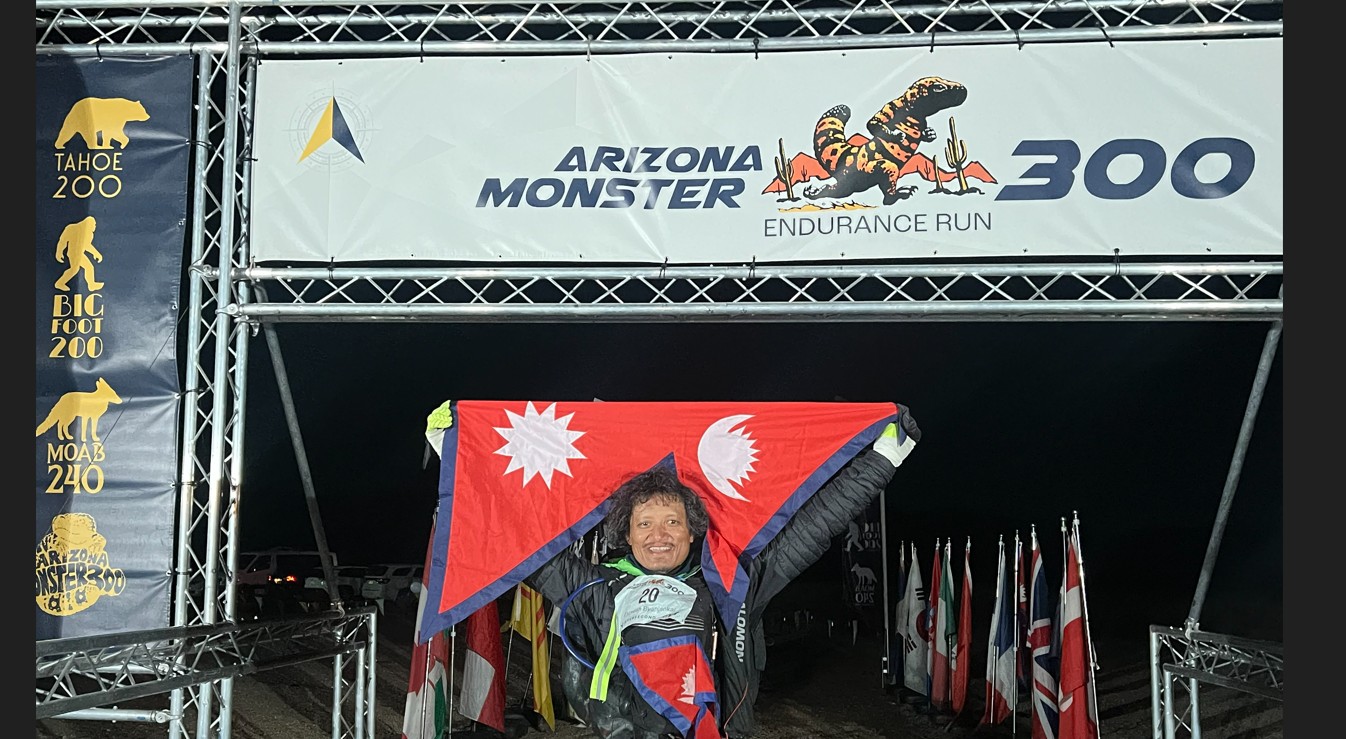
At 3:55 AM on Friday, April 3, after running, jogging, walking and crawling for about 159 hours, the clock finally stopped.
I crossed the finish line of Arizona Monster 300 (about 500 kilometers) with my running brother, Govinda Awale, ending a seven-day war against the Tucson wilderness. We survived the searing, vertical heat of the days and the bone-chilling isolation of the nights. But as the dust settles, I’ve realized a profound truth: the human body can endure almost anything when it is fueled by a dream, but the human spirit only survives when it is held up by a village.
This victory doesn’t belong to my legs and will power. It belongs to the “No. 1 Crew Headquarters and support team”
To My North Star: Anju
There is no race without you. As I always say, your love is the foundation of every mile I run. You don’t wear trail shoes, but your diligence and determination in your own world, your success in education and your unwavering discipline – are the blueprints I follow. You are my motivation when the trail is flat and my inspiration when the mountain is steep.
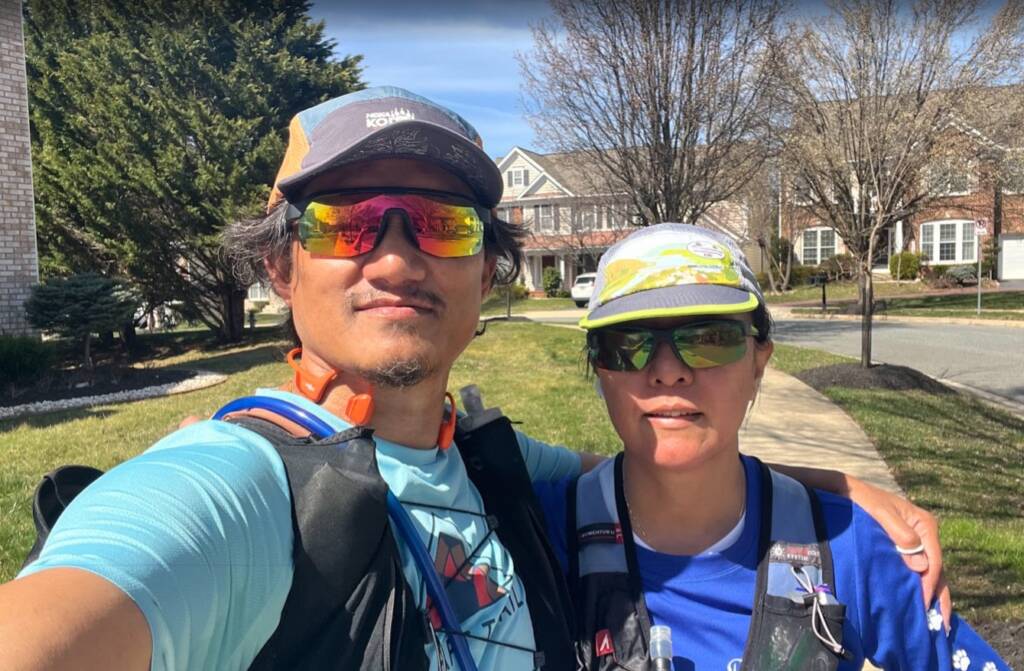
To My Son and nephew: Aatish and Sanir
I felt your absence in the canyons. You wanted to be there, pacing me through the dark. Hold onto that fire. There will be another race, another trail, and another finish line where you will be the one guiding me home.
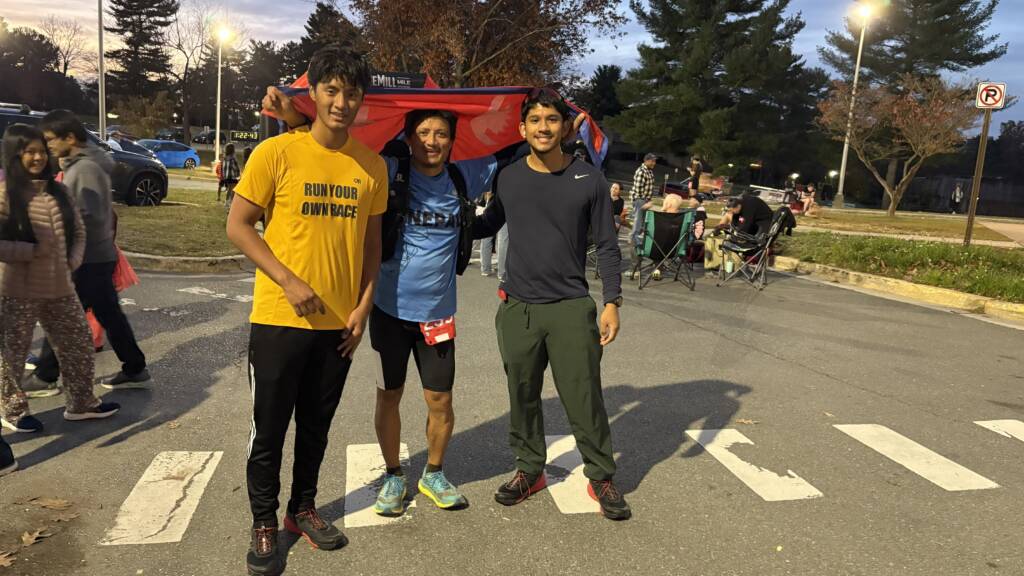
To My Strength: Rayna
You were the reason I didn’t break. In the early days, when heat exhaustion turned my world into a fever dream and the “evil voice” in my head begged me to quit, I saw your text: “Daddy, you got this.” It played on a loop in my mind, louder than the wind, stronger than the pain. I didn’t move forward for a buckle; I moved forward because I couldn’t bear to make you sad. Thank you for being my heartbeat out there.
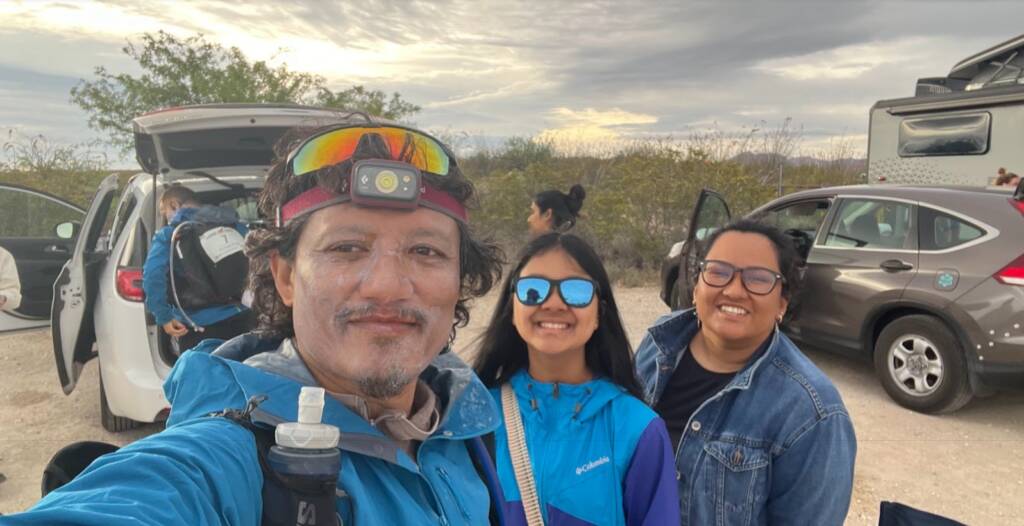
To My Silent Guardians: Rammaya and Family
To my sister Rammaya, Sanu Kaji Dai, Roli, Ranish, and family: I felt your presence. Even though you couldn’t be there physically like you were at the Moab 240, I knew you were with me. I felt the weight of your prayers and support in the silent hours of the night and encouraging texts from all of you. Thank you for holding me in your thoughts from far away. I love you all.
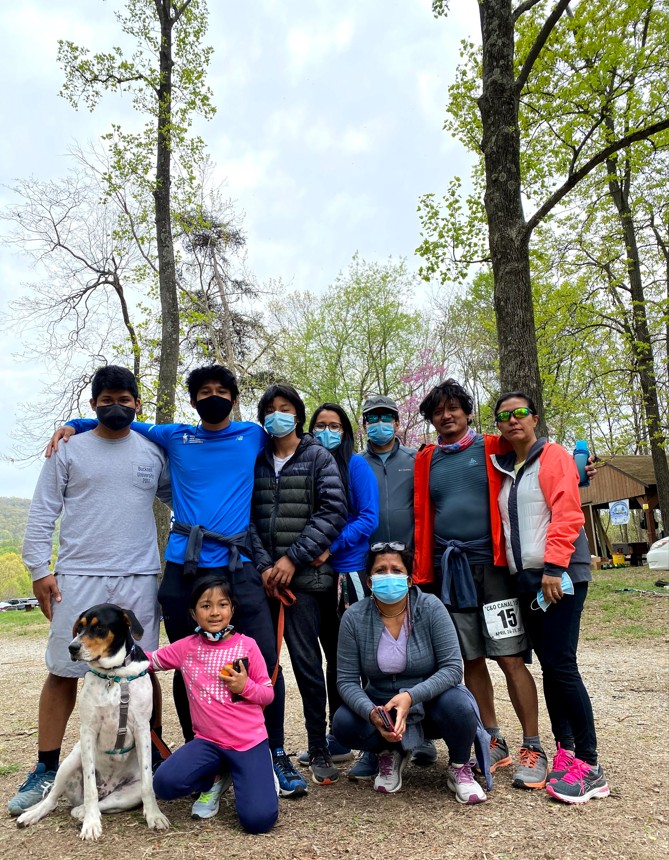
The Lifeline to Nepal: My Shield
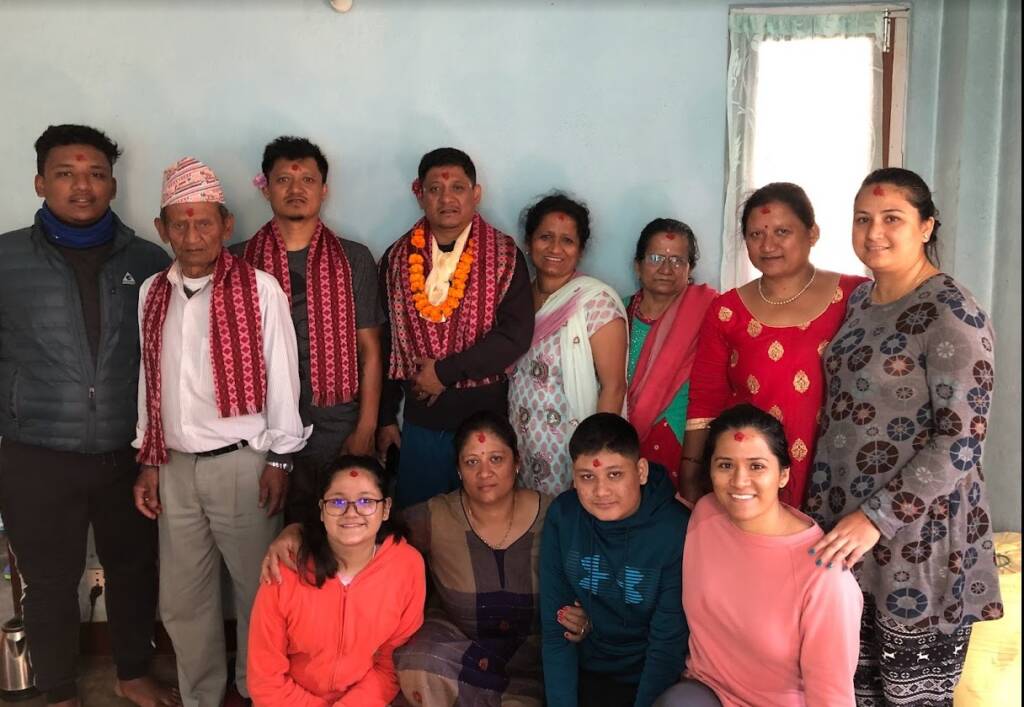
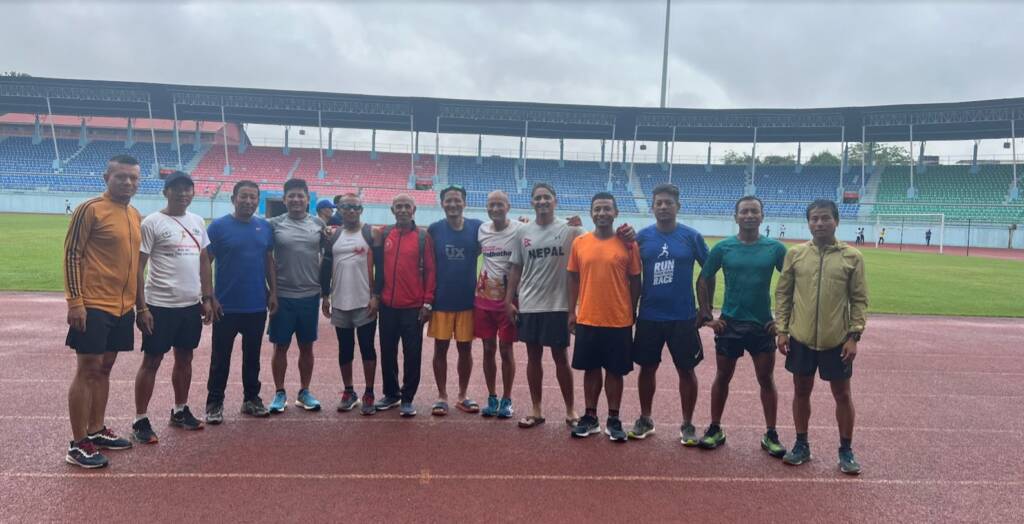
To my mother Chanmaya, father Ram, my brothers Dinesh and Sahadev, and my sisters Sanu Nani, Gita along with all families and friends. To Amaa, Baba, dais and bhaujus…. Thank you and Love you all. Talking to you all during the brutal Mt. Lemmon climb was the ultimate transfusion of spirit. Hearing your voices from Nepal while I was at my lowest point was psychologically and spiritually uplifting. Your love, your support, and your prayers weren’t just “support”, they were a shield I carried through the most difficult hours of the race. I knew you were with me, and I felt your pride in every step.
To My General: Salima
I don’t have the words to match your sacrifice. After Kodiak, I knew I wanted you in charge. While I was “simply running,” you were doing the heavy lifting. You were our chef, our logistician, our medic, and our guardian. You pampered us, you “babysat” two broken men, and you did it with a tireless grace that turned a brutal race into a manageable ritual. You were the critical gear in this machine.
To the Village: Kishor, Yongzom, Kabi, Vedant, Meriya, and Karen
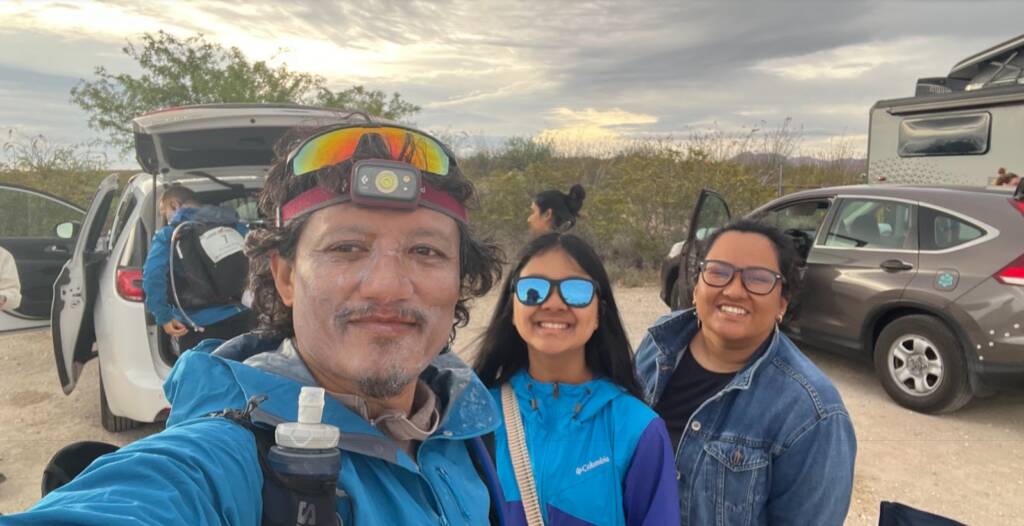
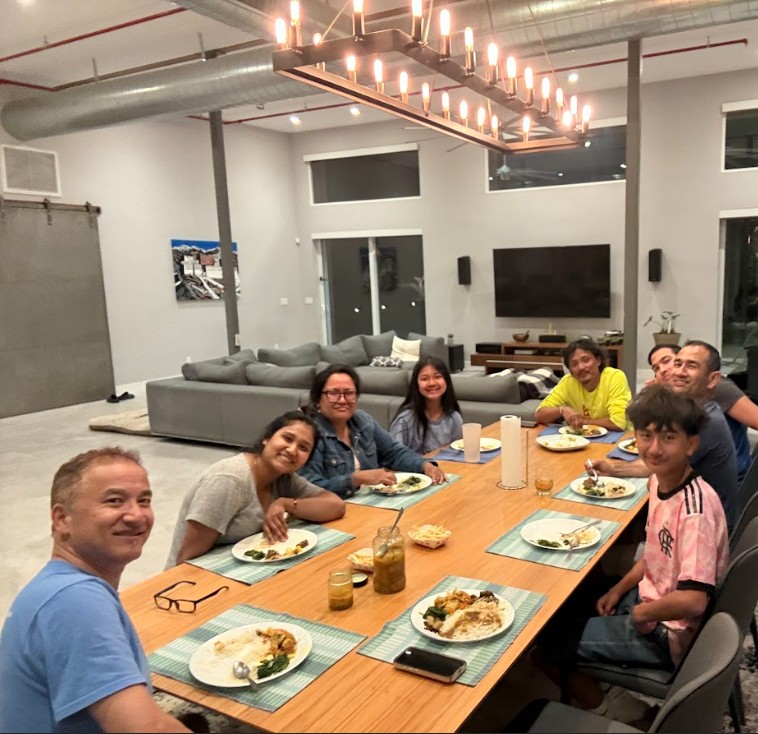
Thank you for opening your doors and your hearts. To Kishor and Yongzom: the authentic Nepali food and the humor at the “Headquarters” were the only things that made us feel human again. To Meriya and Karen, flying in from Virginia just to stand in the dust was the final mental surge to us, more for Govinda.
THE FURNACE: DAY 1 (The Start Line: Superior / Picket Fence / Gila River)
The Oath and the Heat
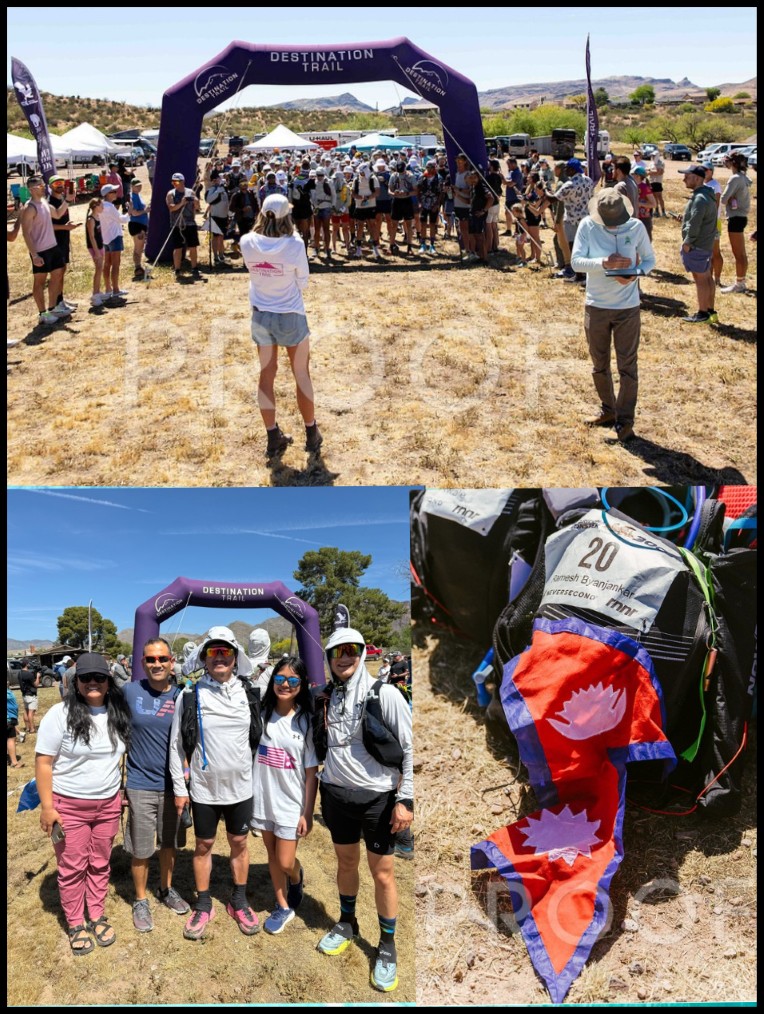
The drive to Superior was a 90-minute glide through scenic, winding roads, a deceptive calm before the storm. By noon, the Arizona sun wasn’t just shining; it was aggressive. A heat wave had turned the desert into a furnace. As we stood at the start with Kishor, Rayna, and Sali, the Race Director’s oath rang out like a grim mantra: “If I get lost, hurt, or die, it’s my own damn fault.” The elite pack vanished into the brush, but Govinda and I settled into a cautious rhythm. We weren’t racing the clock yet; we were racing the sun, trying not to boil before the first sunset.
The Breaking Point
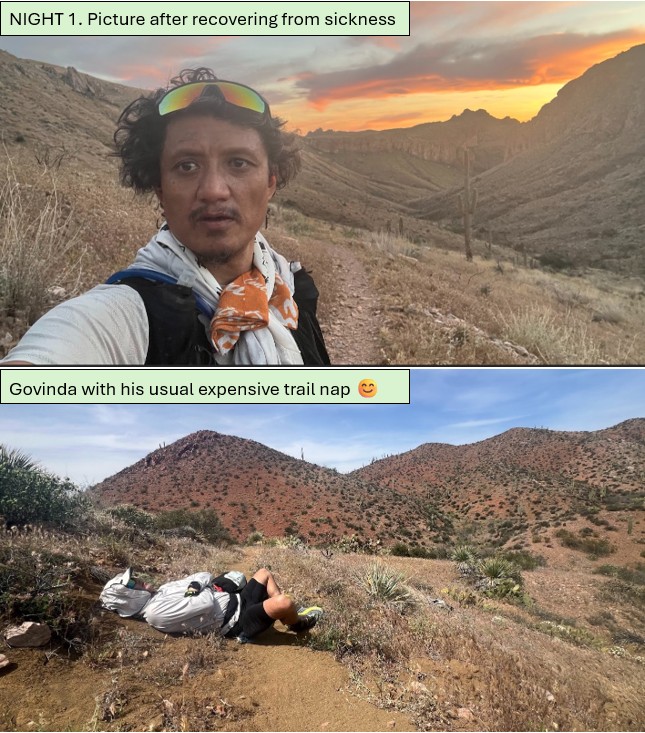
Three hours in, we reached the first aid station: ‘Picket Fence’. I stuffed ice into my water bottles, my pack, and my Ice Bandana, it was the only thing that kept my core from melting. But the desert has a way of finding your limits. Twelve miles later, disaster struck. The heat exhaustion was no longer a threat; it was a reality. Around mile 21, my body gave up the fight. My system violently rejected everything. I sat on a jagged rocky patch, head spinning, as other racers passed with well-wishes from runners that felt like they were coming from another world. In that moment of sickness, there is profound loneliness, even with a partner like Govinda nearby. You realize that no one can breathe for you. I saw the flash of concern in Govinda’s eyes. I wiped the grit and bile from my face with ice water and waited for the calm that follows a storm. In that hollow, empty moment, I chowed down a gel and stood back up. The uneasiness was gone; the survivor had taken over. There is a liberation in hitting bottom early. Once the stomach is empty and the ego is gone, you stop fighting the desert and start moving with it.
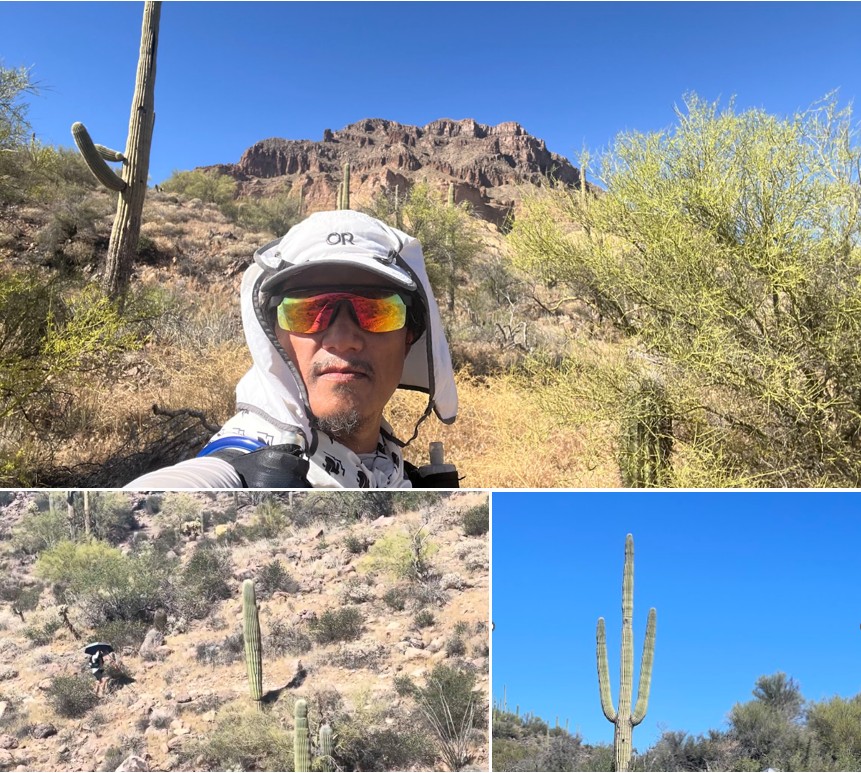
Govinda and his Head Umbrella 🙂
The Gila and the Dark
The trail became a ‘never-ending’ stretch of nine miles. Govinda took a hard fall, leaving skin and fabric on the rocks, but we kept moving. When we reached the ‘Gila River’, it wasn’t just a crossing, it was a baptism. The water was a welcoming roar that pulled the fever out of my nerves. We sat at the aid station for 45 minutes, drinking icy cold Coke and Ginger Ale along with some salty soupy noodles. Anju had taught me few tricks on how to quickly recover from heat exhaustion. As night fell, the psychological warfare began. In the dark, the blinking lights of the ‘Grand Enchantment’ aid station acted like cruel stars. They looked minutes away but retreated every time we gained ground. The fear of the Saturday 6:00 AM cutoff began to seep into our minds. We were far behind. I felt a surge of strength on the big climb. I paced Govinda through the vertical dark, pushing until the mountain finally leveled out. We pulled into the station with only 50 minutes to spare. We ate, refilled, and turned our faces toward Tortilla, our next destination.
The first day tried to break us, but we were still standing. The ritual had begun.
The Gila River Crossing (Blessing in disguise. Cooled our system)
The Toll of the Furnace
As we headed out of the aid station, the air was thick with a different kind of heaviness. It wasn’t just the heat; it was the weight of defeat. We learned that about 45 runners had already DNF’d (Did Not Finish) right there. In the world of ultra-marathons, that number is a massacre. These were strong, capable people who had trained tirelessly, and been brought to their knees by the same sun that had tried to break me at mile 21. In the desert, you are not a “Leader,” or a “Competitor.”, you are simply a guest at the mercy of Mother Nature. If she decides your day is over, it’s over.
DAY 2: THE SCALE AND THE SPIRIT (Tortilla / Freeman / Black Hills)
The Ritual of the Dried River
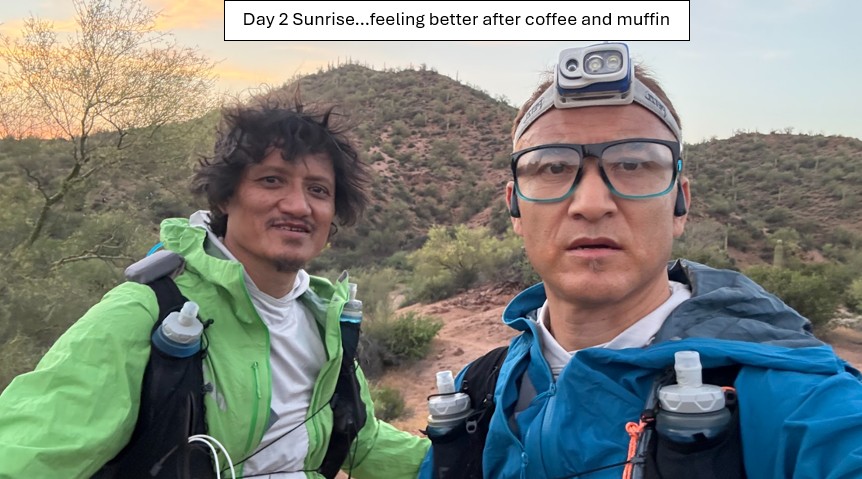
The night was our sanctuary. Running in the pre-dawn hush, the absence of the sun felt like a gift we had to exploit. The routine was same, either climb or descend the narrow rocky trails. We descended into a dried riverbed, a graveyard of stones, where we stopped for a different kind of survival: personal hygiene. There is no luxury in the world that compares to brushing your teeth after two days of grit and dust. That simple act of cleanliness was a psychological reset. I wasn’t just a runner anymore; I was a man restored, ready to face the “Monster” again.
The Wind and the Warning
The climb out was a battle of physics. As the mountain wound upward, the wind transformed into a physical wall. Powerful gusts tried to shove me into the waiting arms of the cactus. I had to plant my feet, lock my core, and wait for the air to relent. It was 45 minutes of treacherous, focused labor before we reached the warmth of Tortilla and the salt of warm noodles.
But the desert had more to say. On the dirt road to Freeman, the silence was pierced by a sharp, rhythmic warning. ‘Chhh-chhh-chhh.’ I moved from the left side of the road to the right in a flash, an instinctual leap fueled by the sudden appearance of a juvenile rattlesnake. It was coiled, vibrating, locked in a striking position. We gave the creature its space and moved back into the relentless sun. The road ahead felt eternal, a shimmering line of heat that seemed to stretch into the next life. Throughout the hot day in trail, we encountered numerous rattle snakes. One thing I learned from this experience is that we must give these creatures their space.
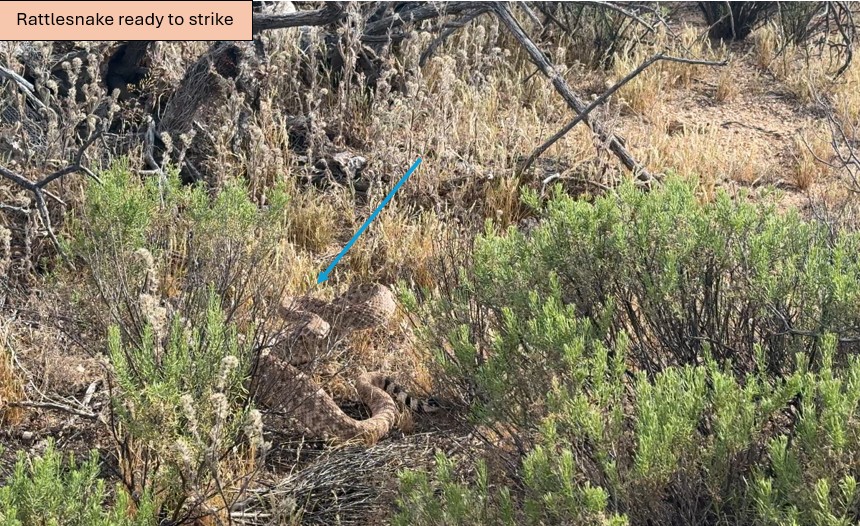
Govinda started talking to Rattlesnake. A Snake charmer in making?
The Heart of the Race
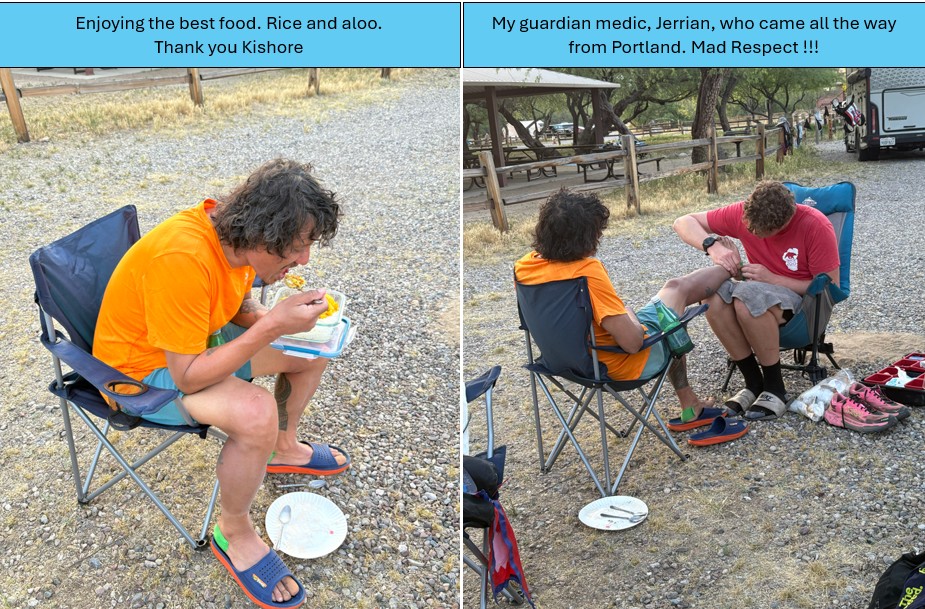
The road to Freeman was a treadmill of despair. My feet were a map of hot spots, but I was starving for the salt of home. When Rayna and Salima finally emerged from the heat haze, the emotional dam broke. I’m a leader, a mentor, an athlete, but in that moment, I was a father, an uncle being found by his child in the wilderness. At that moment I was a “Dad” rather than another “Runner”. I choked it back. I hid the tears behind the dust. I ate the Rice and Aloo curry, the food of our people and let the salt stabilize my soul. After a bowl of salty Rice and Aloo curry, the best meal of my life and a brutal session with the medic to tape my screaming blisters, I stole an hour of sleep in the back of the car. It wasn’t enough, but it was all the desert would allow.
Disappearing in the Dark
The Timekeeper of the Dark
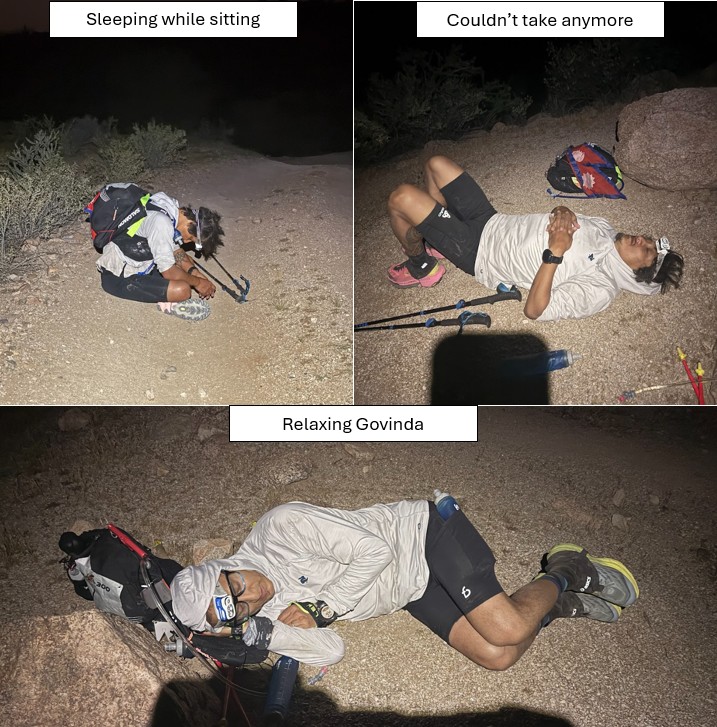
As we headed toward Black Hills, the second night brought the heavy fog of sleep deprivation. Govinda’s feet caught on the sand pebbles, and he went down again. He was safe, but his mind was drifting. He needed sleep, but the trail is a jealous master. We stopped about four times on the trail. I could not sleep, the adrenaline and the responsibility kept my eyes open, so I became the timekeeper. I sat in the dark, watching over my “running brother” as he stole ten-minute naps in the dirt. We climbed, we descended, and we pushed through the exhaustion until we saw the lights of the aid station. After eating freshly baked vegetable pizza and fresh tape, I took a 30 minutes nap under a warm blanket. It was not a recovery; it was a stay of execution. We stood up, adjusted our packs, and disappeared back into the dark towards our next aid station, Tiger Mine.’ This is where I met Jurrien for first time, a volunteer medic from Southern Portland helped me with my blisters. In fact, he helped me with water and ice at the first aid station.
Dependency on minimalistic signs and GPX
DAY 3: THE THROAT OF THE MONSTER (Tiger Mine / Oracle / Mt. Lemmon)
The Scale and the Serpent
The third morning began with a lesson in patience and respect. The Arizona desert does not just offer beauty; it offers guardians. Carolyn, leading our small pack, halted us twice within twenty minutes. The first was a massive, stubborn Rattlesnake stretched across the trail like a fallen branch that refused to be moved. We threw pebbles, we waved sticks, but it held its ground with cold indifference. We were forced to navigate a wide, tense arc around it. Fifteen minutes later, a second, more aggressive snake hissed from the roadside. We hurried past, the adrenaline spiking through our fatigue as the sun began to turn the “exposed” trail into an oven.
Another Rattlesnake blocking our trail 🙂
Finished 1st 100 miles of the race in 44 hours. We had about 3 hours sleep. 200 more miles to go.
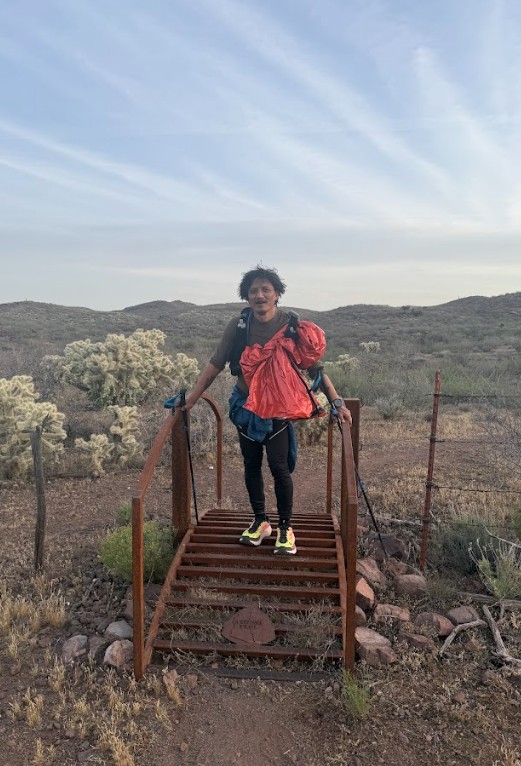
By the time we reached ‘Tiger Mine’ at the welcoming arms of Sali and Rayna, the heat was a physical weight. I cooled my internal engine with ice-cold Coke and ginger ale, but my mind was already on the geography ahead. I made it a ritual to recheck my blisters, maintenance is the only way to survive a 300 miler. I looked at Govinda and reminded him of the paradox: we were currently boiling, but we were heading for the freeze. I asked him to pack his “cold gears”, base layers, tights, and jackets. We were not just running; we were preparing for a different climate. After eating Rice and Aloo and mandatory 90 minutes nap in the back of the van, we slowly disappeared in the dusty road towards the trail to Oracle. Sali and Rayna were able to capture some video and pictures of our struggle.
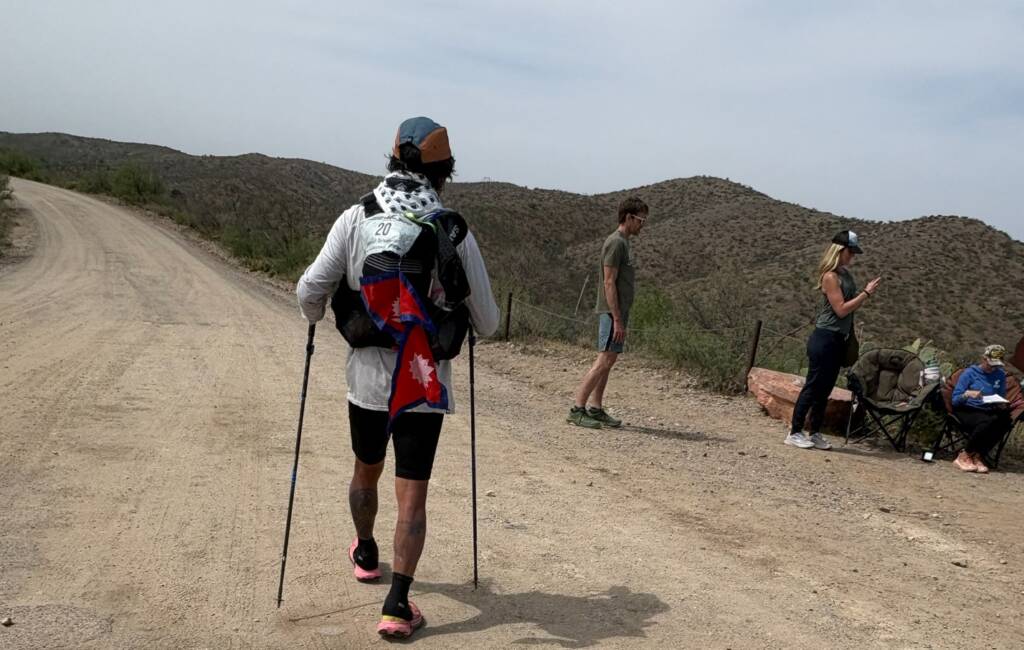
Customary visit to the medic for taking care of blisters
So good to hear Rayna and Sali’s voice. It meant a world for me
The nine-mile stretch to Oracle was a gauntlet of exposure. There was no shade, no respite, only the relentless Arizona sun pressing down on our shoulders. The first seven miles were a test of endurance; the last two were a test of sanity. The desert has a way of stretching time. Those final two miles felt like they belonged to a different day entirely. The heat was “scorching,” a physical wall that we had to push through with every breath. The trail seemed to lengthen as we walked, a shimmering mirage where the horizon refused to get closer. We were moving, but the world felt stationary. When we finally limped into the Oracle Aid Station, I did not want water, I wanted to drown the fire in my core. I downed three or four glasses of ice-cold Coke and Ginger Ale, the carbonation cut through the dust in my throat. We ate vegetable burgers and omelets with a desperation that only comes when you know the “Monster” of Mt. Lemmon is finally standing directly in front of you.
Taking refuge under shade: Amelia (Australia) and Jeremy (Falls Church, VA). So close to Oracle
The Ascent of Mount Lemmon: Voices as Oxygen
We fueled up at Oracle aid station, veggie burgers, and a flood of ice-cold soda, knowing we were about to walk into the jaws of the true “Monster.” Mount Lemmon. It loomed 9,000 feet above sea level, demanding a 6,000-foot vertical sacrifice. To make the scene even more ominous, the sky began to bruise; dark clouds rolled in, and lightning flickered like a warning.
Oro Valley… far away as seen while ascending Mt. Lemmon
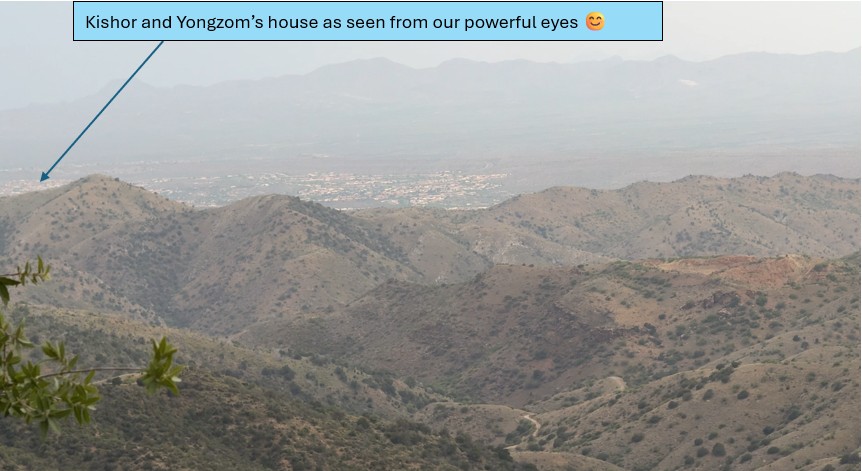
As we began to grind up the steep, rocky trail, we found a rare moment of stillness, a flat shelf of earth where we took fifteen minutes break. In the middle of that vast Arizona wilderness, I reached for my phone. I called my brothers, Dinesh, Sahadev, Rajesh, my sister Gita, and my nephew Ronish. In a race that strips you of everything, hearing their voices from Nepal and home was like a transfusion of pure spirit. It was “mentally and psychologically uplifting”, I was not just a runner anymore; I was a brother and an uncle being carried by this family’s pride.
With that “support in our arsenal,” the steep dirt road did not feel impossible. We felt strong. We felt unstoppable. Another runner, Justin, watched us power upward and marveled: “You guys are simply walking in this crazy steep road.” But we were not just walking; we were moving on the energy of people thousands of miles away.
The False Summits (The never ending climb)
But the “Monster” was not the incline; it was the deception. We crested one peak only to find another. Then another. We saw the blinking lights of the aid station in the distance, but like a mirage, they seemed to retreat every time we gained ground. This is where the mental breakdown begins. Both Govinda and I, haunted by sleep deprivation, kept asking the question no ultra runner should ask: “How far? How long?” I even started asking about it. I gave him the only truth I had left: “Don’t think about it. Just one foot in front of another.”
The Seventh Mountain (Confused, dazed and GPX)
We struggled and stumbled through dangerous, scary trails for 8 hours and 15 minutes. It felt as though we had climbed seven separate mountains before the final ridge gave way. Seeing the volunteers at the summit was one of the most relieving sights of my life. I did not celebrate; I didn’t boast. I spent 20 minutes refilling my bottles and loading up on carbs before crawling into a tent for two hours of deep, obsidian sleep. At 5:00 AM, Govinda woke me up. The climb was a memory, but the descent and another 175 miles of unfinished business were waiting. Along with Amelia from Australia and Jeremy from Falls Church, VA, we stepped back into the chilly morning air and began the long walk down.
DAY 4: THE DESCENT AND THE DISCIPLINE (Charloux Gap / Catalina / Rillito)
The Roar of the Gorge
The descent from Mount Lemmon was a four-hour gamble with gravity. Every step was a calculation, one wrong move, one slip on the treacherous, steep trail, and the gorge below would claim the debt. But as the vertical world began to flatten, the silence was replaced by a soothing, distant sound that grew into a roar. Water. Plunging my hands into that cold river was a jolt to the nerves. It was a physical awakening that shocked the fatigue right out of my system. While Govinda, haunted by the sleep he could not find on the mountain, succumbed to a nap, I performed the ritual of the weary. I peeled off my socks and let the air hit my burning skin. In that moment of relief, Arizona vanished. Looking out toward the Oro Valley, the hills felt like the foothills of Chandragiri back in Nepal. I even joked to Govinda about calling Kishor for a proper breakfast and coffee, a momentary bridge between this survival struggle and the comfort of home.
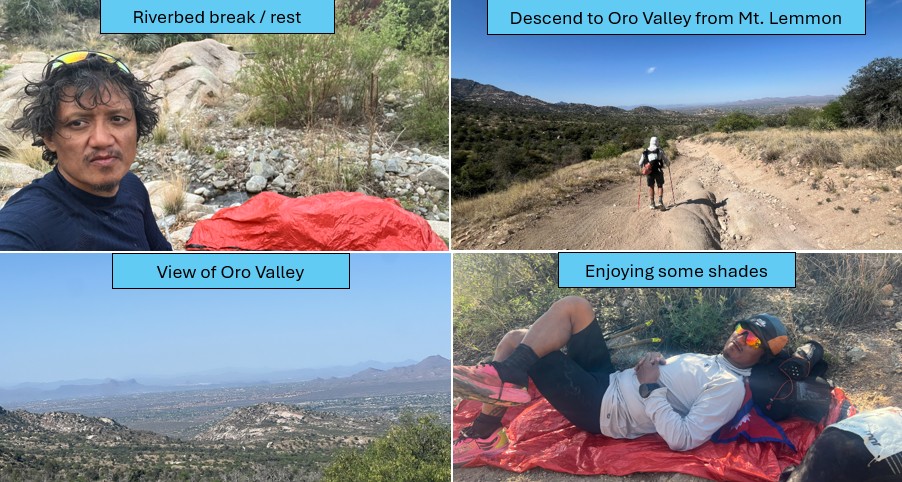
Govinda got drunk after sleeping LOL
The Mirage of the Desert
We moved through ‘Charloux Gap’ in a furnace of heat, fueled by ice-cold Coke and the familiar faces of volunteers from Maryland. But the eight-mile stretch to our next destination ‘Catalina’ was its own brand of purgatory. The heat was scorching, the trail markers were non-existent, and the entrance to the aid station felt out of reach. When we finally arrived, a volunteer handed me a cup of icy mango-watermelon slushy. It was raspy, sweet, and freezing; it did not just cool my throat, it cooled my soul. And the best part of this entire adventure was having cold shower. It washed away not only the dirt, but the tireness and pain from within inside. Jerrian, our guardian medic, went to work popping new blisters and re-taping the damage. We fell into a 90-minute sleep that felt like five seconds before Rayna and Sali’s voices pulled us back into work.
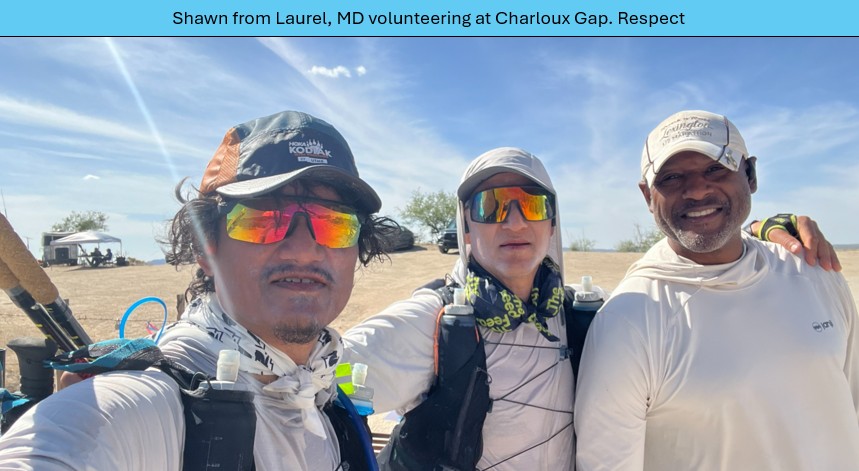
Govinda’s promise in Newari. You know he is hallucinated 🙂
Catalina…This is where we met Sali and Rayna
Heading out to bike path to Rillito from Catalina
The Concrete and the Conscience
We traded the sand for the flat, unforgiving Tucson bike path, a 42-mile blacktop road. With light clothes and minimalist packs, the strategy was simple: move fast, reach the food, and find the rest. For 13 miles, we held an 11- 12 minute-per-mile pace, our feet slapping the flat, unforgiving concrete. We were not trying to outrun the other athletes; we were trying to outrun the exhaustion. But the “Monster” does not just eat your muscles, it eats your mind. With my watch dead and my internal clock fractured by days of exertion, my mental math failed me. I had promised Sali we would be at Rillito by 11:30 PM. When we finally limped into the station at 1:30 AM, two hours late, the guilt was heavier than my backpack. I saw Sali there, standing in the chilly morning air, ready with our gears and the food that had become our lifeline. I started to apologize, with the fatigue of the “mental miscalculation,” but she cut me off before I could finish. “I am here because I am your crew, and I need you to finish” she said.
The king of Denmark: Tommy sharing bike path with us
Limping into Rillito Aid Station. Saw Sali there. Thank you and Love you chori
In that one sentence, the hierarchy of the race shifted. I was the one running, but she was the one holding the line. She had been moving across the stations, navigating logistics, and fighting her own sleep deprivation just to be my shadow. Even though I urged her to go home and rest, her presence was a reminder: you do not finish a 300-mile race alone. You finish it on the back of people who refuse to let you fail. We ate quickly, packed our gear in a haze, and watched her drive off into the night. But sleep deprivation is a thief. In the haze of prep, I made a critical error: I grabbed extra shoe gaiters instead of the fresh socks I desperately needed. Now, I faced the next 45 miles with feet that felt like they were being fried on a skillet, trapped in the same salt-crusted socks. After sleeping for about 2 hours, around 4:30 AM, we headed back to the bike path. However, the environment has shifted. We passed through sketchy stretches where the vulnerable and the forgotten were fighting their own demons in the shadows. Watching people drink and curse in the heart of the “richest nation” while we spent billions on war and excursions was a jagged pill to swallow. It was a stark reminder that while we were fighting a mountain for a buckle, they were fighting a system for their lives. We moved past them in silence, carrying the fire in our feet and the weight of that reality in our hearts.
The ritual continues. The path is long. And the ghosts of the city are now walking with us.
DAY 5: THE BLACKTOP AND THE BENEVOLENT (Valencia / Pistol Hill)
The Ritual of the Blacktop
As the distant sunrise bled into the sky, the Tucson bike path hummed to life. Local bikers and morning joggers began to filter past, their expressions shifting from curiosity to pure amazement as they learned we had been moving for five days straight. We stopped at a coffee shop right on the path, a small, civilized oasis in a world of dust. Sitting there with seven or eight other runners, clutching hot coffee and real breakfast, felt like a luxury we had not earned but desperately needed. But the “Monster” reclaimed us quickly. The morning sun turned the blacktop into a radiating griddle. The heat was relentless. Every mile on that concrete was a slow burn. But then, like a neon sanctuary in the middle of the haze, we saw it: Circle K. We sneaked in, two ghosts of the trail covered in five days of Arizona dust and salt, looking completely out of place among the Saturday morning locals. We did not want fancy electrolytes or high-performance fuel; we wanted the coldest thing the modern world could offer. We filled two massive cups with icy Slurpee, a frozen, sugary jolt that hit our systems like a lightning bolt. I cannot describe the feeling of that first sip. It did not just cool my throat; it felt like it was putting out a fire that had been burning in my core since Day 1. For those few minutes, standing in the air-conditioned hum of a gas station, the 305-mile ‘Monster’ was forgotten. There was only the ice, the sugar, and the pure, unadulterated joy of being alive. It never felt so good.
Day divides the night in bike path
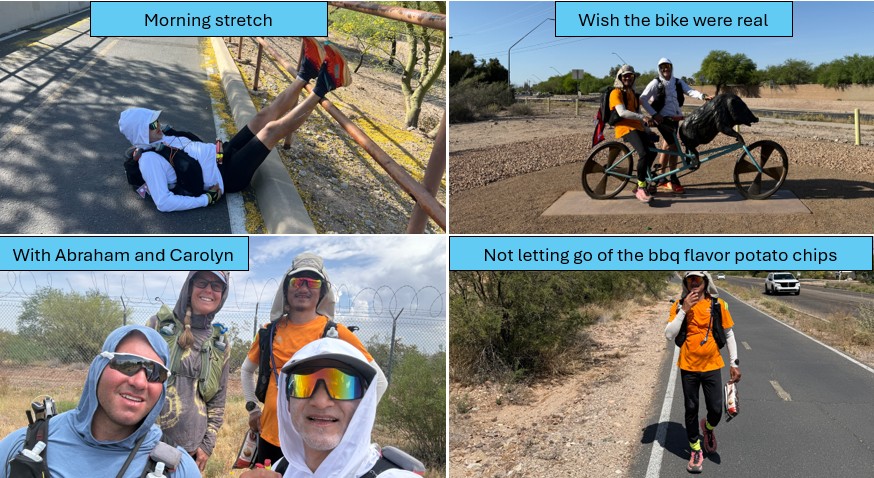
However, Mother Nature has its own plan. After enjoying ourselves for couple of hours, we fell into reality, a hot oven. Under the sparse shade of a lone tree, Govinda, Amelia, and Jeremy collapsed. Within seconds, the rhythm of Govinda’s snoring filled the air, a sound I captured on video as a testament to the absolute exhaustion of the human frame. After taking 20 minutes break, we passed through one of the ends of Davis-Monthan Air Force Base where we saw fighter planes humming and zigzagging through the clouds in a flash. After almost 42 miles of bike path, we entered the trail again where we belonged.
I was not letting go of the potato chips. Carried for 110 miles to crew headquarters
Hydrating and cooling anyhow. Every drop counts
The Blessing of the Rain
Valencia welcomed us with the kind of cheering that stitches a tired heart back together. After two veggie burgers and an omelet, the sky opened. It rained for only fifteen minutes, but it was a “blessing in disguise,” a sudden cooling that felt like the desert was finally showing us mercy. However, the path ahead grew grim. We marched past scenic roads that had been choked with debris and dumping sites, eventually hitting a four-mile stretch of a high-traffic road. We walked a narrow, dangerous edge as cars screamed past. This was a different kind of endurance, not against nature, but against the mechanical world.
One of the best Aid Station Crew at Valencia
The Guardians of the Road
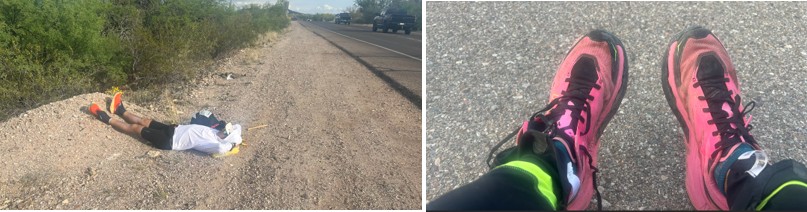
It was here that Govinda finally broke. He did not look for shade or a soft spot; he simply lay down on the gravel by the busy road. My worry spiked, but then an old lady pulled her car over. She came to ask if everything was ok with Govinda. I assured her that he was just taking a quick break after running for 5 days. She told me that she cared about us, human beings and said, “When I go home and watch TV, I don’t want to see that someone died when I could have helped.” Her words were a profound reminder: even in the middle of a desolate stretch of road, there are beautiful, loving souls looking out for the vulnerable. Later, a past runner and his wife appeared like a mirage, handing out water and chips. In a race of 305 miles, it’s these brief flashes of human kindness that keep the legs moving when the ‘shield’ of the mind begins to thin. After running through 3 miles of wide dirt road and another 3 miles of trail, we came to ‘Pistol Hill’ aid station. As we stepped back into the trail, a cold, five-minute rain greeted us, a final, chilling kiss from the sky before we turned away from the roads and toward the welcoming, dark arms of the mountains.
Can’t wait, won’t wait for shade. Where I lay my head is my home
The Single Pole and the Mountain’s Hug
At the self-serve ‘Pistol Hill’ aid station, the race stripped more away. My 4th right toe was screaming for attention, so I became my own medic, layering tape over tape in a desperate attempt to reach the next relief point. Govinda became another medic who helped me to clean my toes. Then, my gear failed, one of my poles snapped, its locking mechanism gone. I did not panic. I ditched the dead weight and learned, on the fly, the unbalanced rhythm of a single pole.
The ritual continues. One pole. One toe. One step.
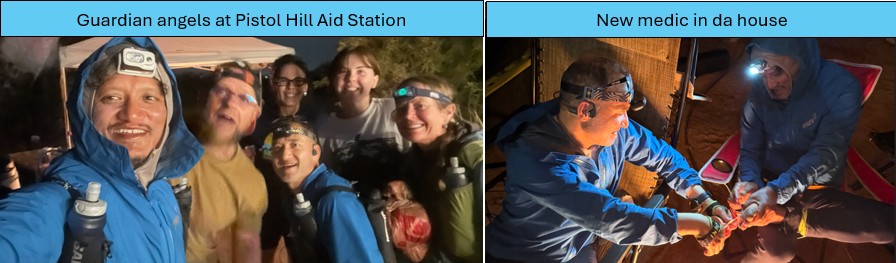
Balens of Pistol Hill Aid Station
DAY 6: THE CAGE OF THE SIERRAS (Gabe Zimmerman / Santa Rita / Oak Tree)
The Narrow Ledge
The night felt like a cage. As Carolyn, Govinda, and I climbed into the high ridges, the mountains rose around us on all sides, trapping us under a dome of cold stars. We moved through gorges and across ridges in a daze, feeling like we were walking in circles through a celestial arena. Then, the mountain nearly took its toll. On a narrow, jagged ledge, Carolyn’s footing failed. I watched her tilt toward the abyss, where a cluster of cactus thorns waited like bared teeth. I lunged, catching her shoulder just as gravity took hold. Because of the bulk of her backpack and my grip, she did not plummet, she only took a few thorns to the back instead of a disaster to the head. We stood there for a second, hearts hammering against our ribs, before continuing the slow, silent descent.
The lights of the Gabe Zimmerman aid station taunted us from four miles out. Govinda, breaking under the weight of his 35-pound pack, begged for a break. I pretended not to hear him. As a pacer, you sometimes must be the ‘cruel’ one to be the kind one. I knew if we pushed those last 1,200 meters, he would not be sleeping in the dirt; he’d be in a warm cot. We made it. We collapsed. Three hours of deep, obsidian sleep – the best of the race.
Coming to Gabe Zimmerman Aid Station (dead tired) where we met full force of our crews
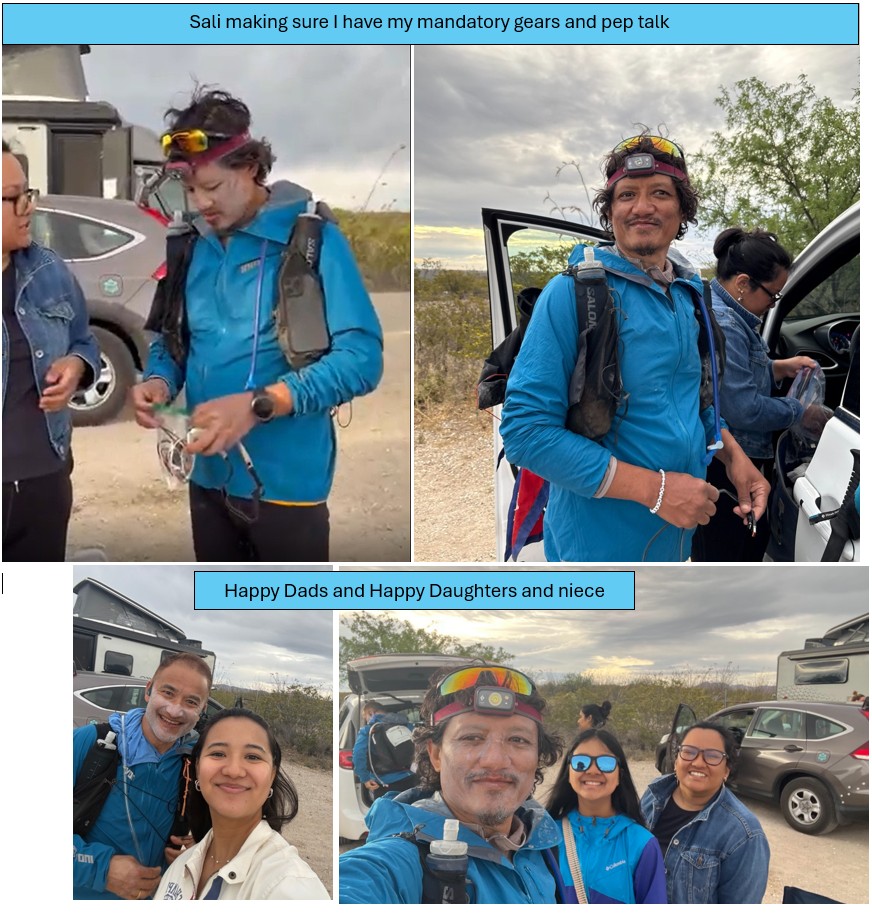
Ready to head out after 3 hours sleep. We overslept by an hour
Light in the end of the tunnel
The Red Dirt and the Long Road
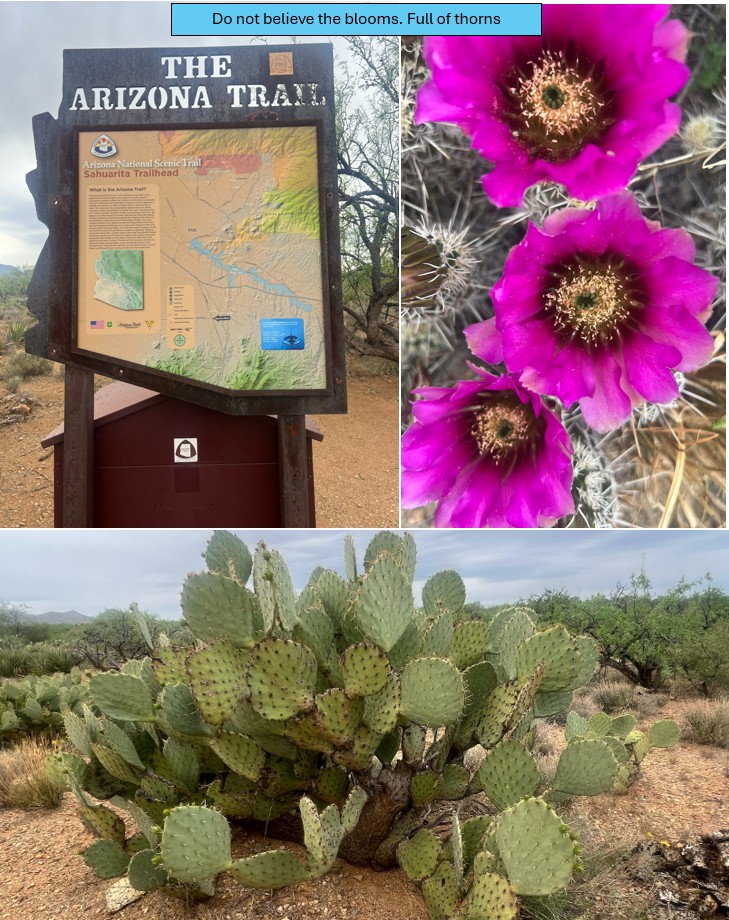
Dawn brought the crew, this time addition of Govinda’s daughter Meriya and her friend, Karen and the familiar comfort of ‘Rice, Aloo, and Baji’. We fueled our bodies with the food of our ancestors, packed up our mandatory gears, and stepped onto the red dirt trails toward Santa Rita. The desert was in bloom, pink cactus flowers mocking the grey fatigue in our bones. Again, the Maryland connection appeared, volunteers from Laurel and Frederick standing in the dust like old friends at ‘Santa Rita’ aid station. After quick in and out from this aid station, we marched for next18-mile stretch to Oak Tree, which was a psychological gauntlet. Wave after wave of hills. Climb, descend, repeat. We ran into Abdul, and for a fleeting moment, the Arizona Trail was filled with the sound of Nepali, a lifeline of language in a wilderness of static. He facetimed his Nepali friend in New York and we had a brief conversation in Nepali. It felt so good. We left Abhraham behind as he tended his feet. We passed a man-made cow pond, the first sign of ‘civilization’ in a world that felt increasingly alien. By the time the air turned cold and the shadows lengthened, we finally saw the lights of Oak Tree. We ate like kings, veggie burgers, and omelets, full of two rounds and surrendered to a 90-minute rest.
Changing to new shoes helped me propelled to next aid station: Santa Rita
Govinda enjoying some run time in trail
The Heartbreak at 246 Miles (Oak Tree Aid Station)
As we were resting and prepping to head back into the dark, the ‘Monster’ showed us its teeth. I watched a 65-year-old runner, a woman who had been a pillar of strength, someone we had traded places with for days, try to stand. Her back was gone. I saw the medic’s hands on her, saw the grimace of agony on her face. She tried to leave. She wanted to finish. But ten minutes later, she walked back into the station with tears streaming through the dust on her face. She called it. After 246 miles. She disappeared under the blanket with broken heart and agony. It broke my heart to watch her. To give every ounce of your soul for six days and have your body veto your spirit at the eleventh hour is a special kind of grief. But she taught me the final lesson of the AZ Monster: You can argue with your mind, but you must listen to your body. If you do not, the mountain will make the choice for you. We stepped away from the warmth of the station and back into the dark, carrying her 246 miles with us. We have 54 miles left to honor the ones who could not finish.
The ritual is almost complete. The body is screaming, but the blood remembers the way.
Coming to Oak Tree Aid Station. Desperate for rest
What sight. A paradise. Had one of the best omelletes. Thank you volunteers
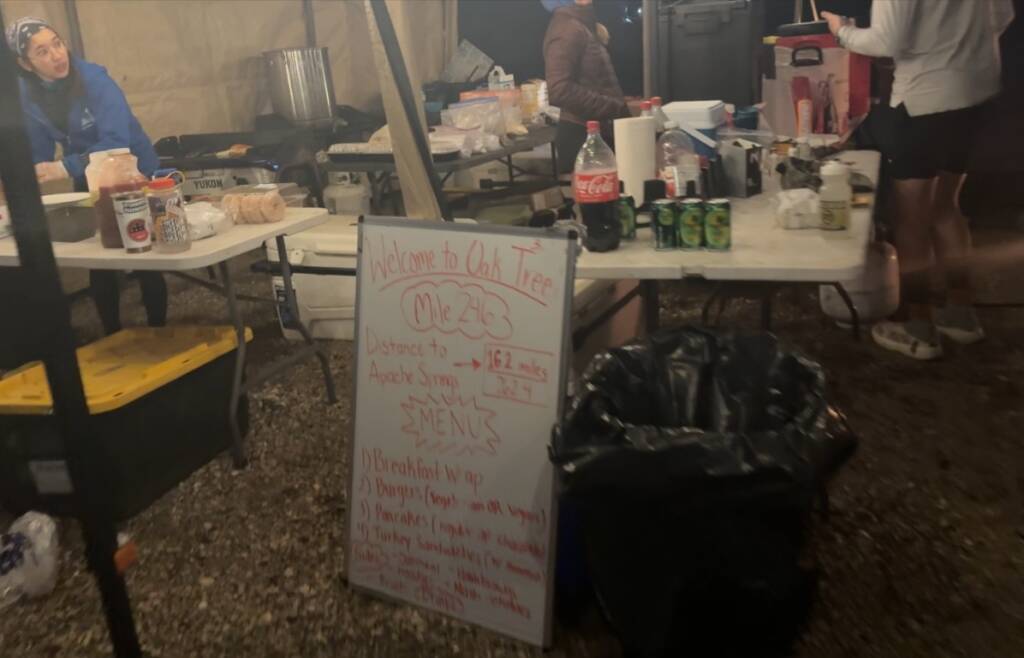
DAY 7: THE FINAL RITUAL — BLOOD, DUST, AND BROTHERHOOD (Apache Springs / Casa Blanca / Patagonia (Finish Line)
The Burning Ground
By the time we turned toward Apache Springs, the pain had evolved. It was no longer an ache; it was a screaming, chemical burn. Every step felt like my feet were being pressed into white-hot coals. In the dead of night, the desert played tricks. As the night crawled in, we asked Abhraham about the next aid station. He told us that it was about two miles away; he was probably wrong. It was about four miles of technical, jagged trail with a big descent that felt like an eternity. We were about 5,000+ feet above sea level and it was freezing cold. Piercing through the night and never ending cold gorge was painful.
It was cold, but we need to keep moving
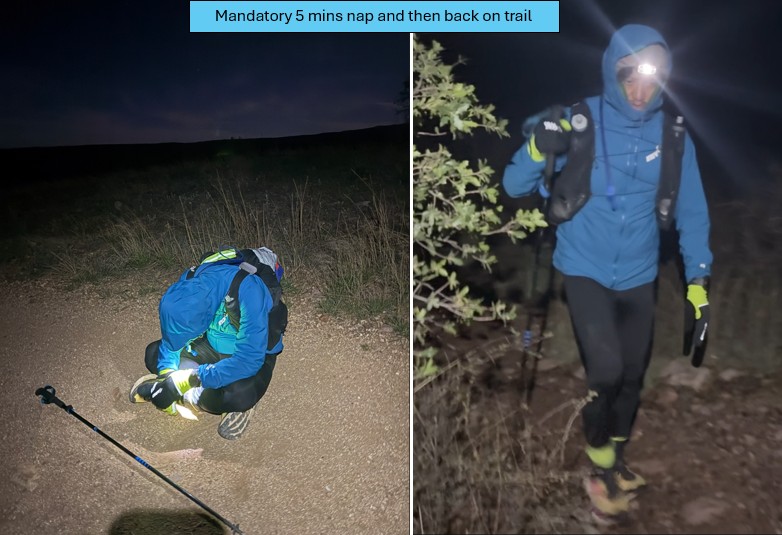
Finally Apache Aid Station
When we finally arrived, the station was a graveyard of broken bodies. I slumped into a plastic chair and vanished for twenty minutes. Jerrian, the medic who had become my silent guardian, worked on my feet with a tenderness I will never forget. He even handed me his own water bottle for the final push. I left that station with a broken mind, but a heart full of respect for the strangers who keep us alive out there.
The Shin and the Pact
Around 8:00 AM, with the final miles looming, disaster struck. Govinda stopped. A sharp, localized pain flared in his left shin, the kind of pain that can end a race 290 miles in. My “doctor mind” took over. I made him sit. I wrapped his leg in Ice Bandana and gave him an Advil. I called my wife, Anju, back on the East Coast, a real medic to guide us through the crisis. The ultra-family provided the rest; a random runner handed over a handful of Tylenol capsules like it was a holy relic.
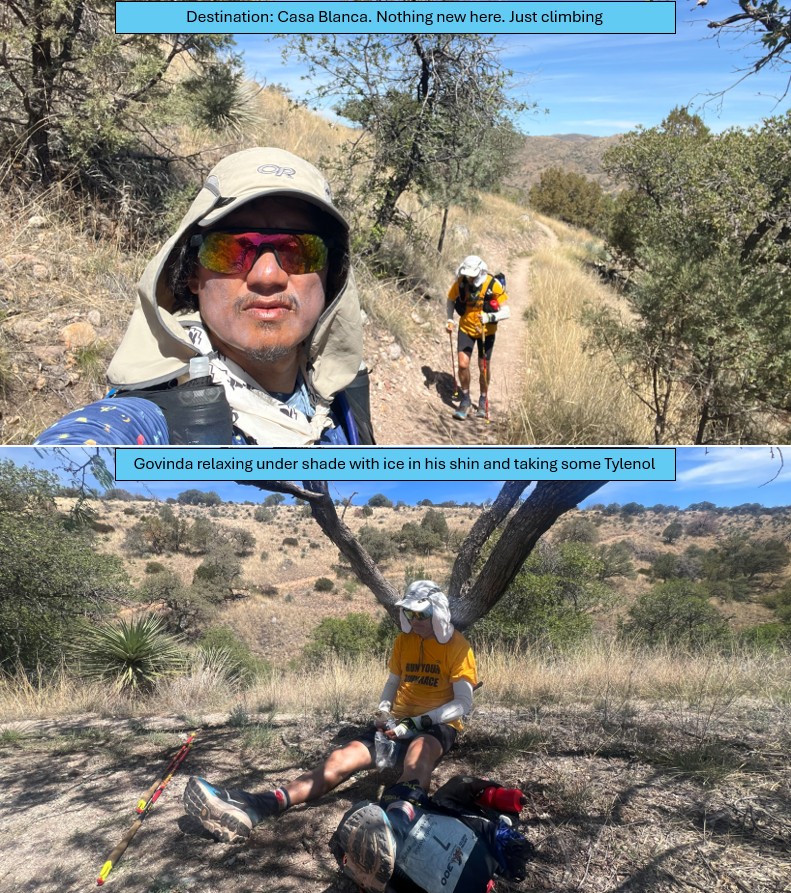
I looked at Govinda. I knew the runner’s mind, the desire to hide pain to reach the goal. I made him promise honesty: “If it is sharp, you tell me. I am not leaving you behind. If we give up, we give up together.” For us, the ritual is not about the buckle; it is about the brotherhood. We move together, or we do not move at all.
Runners enjoying some daytime nap
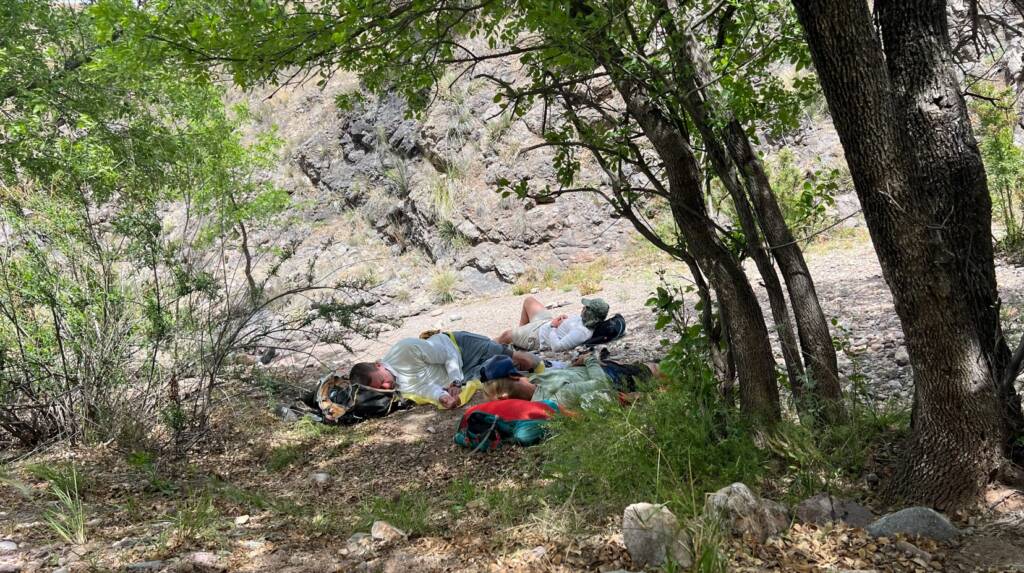
But someone woke them up with his natural alarm 🙂
The Oasis and the Sob
We pushed through the wavy, technical trails for twelve miles until the desert suddenly gave way to an oasis of greenery: Casa Blanca. When I saw Sali and Rayna waiting there, the wall finally came down. I hugged Sali and sobbed into her shoulder. I could not hold it anymore. It was not just the pain or the heat; it was the overwhelming weight of being almost home. I plunged my burning feet into a bucket of icy water, a relief so profound I cannot put it into words. After about 2 hours sleep and one final check by Jerrian on my feet, we were ready for the final segment. Nothing was stopping us.
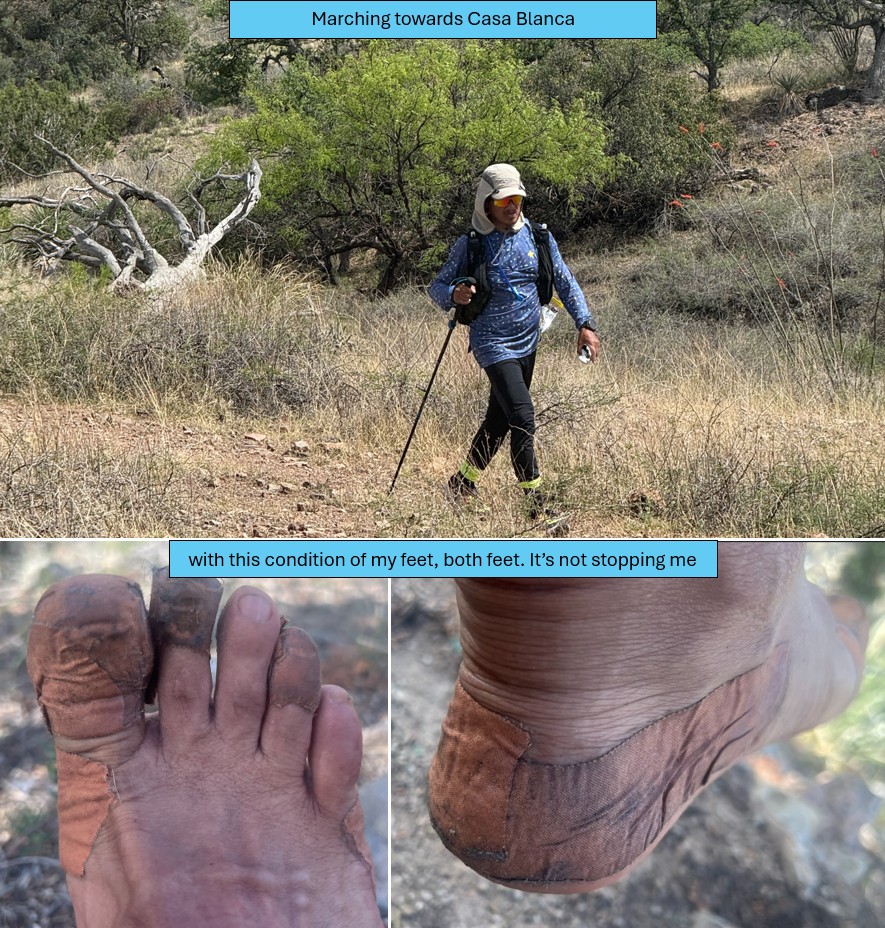
Finally at Casa Blanca. Couldn’t hold my emotions
Jerrian, my new best friend as per Rayna. He definitely became one. Such a nice person
The Final Segment: 305 Miles Home
At 8:00 PM, under a cold, blistery canopy of stars, we stepped into the final 16.5 miles. The night was a sanctuary. In the beam of a headlamp, the world disappears. For the first time in six days, we stopped talking about the ‘Monster.’ We talked about life, family, and work. After 150 hours of shared suffering, we finally found the space to be men again, not just machines.
Then, the ‘running mind’ took over. We saw Carolyn’s lights and, for reasons, the soul understands but the body hates, we began to jog. The jog became a run. For three miles, we flew, forgetting the blisters, forgetting the 52 years of gravity. But the desert always collects its debt. Govinda’s shin flared, sharper this time. We stopped. We medicated. We leaned on each other for the final climb.
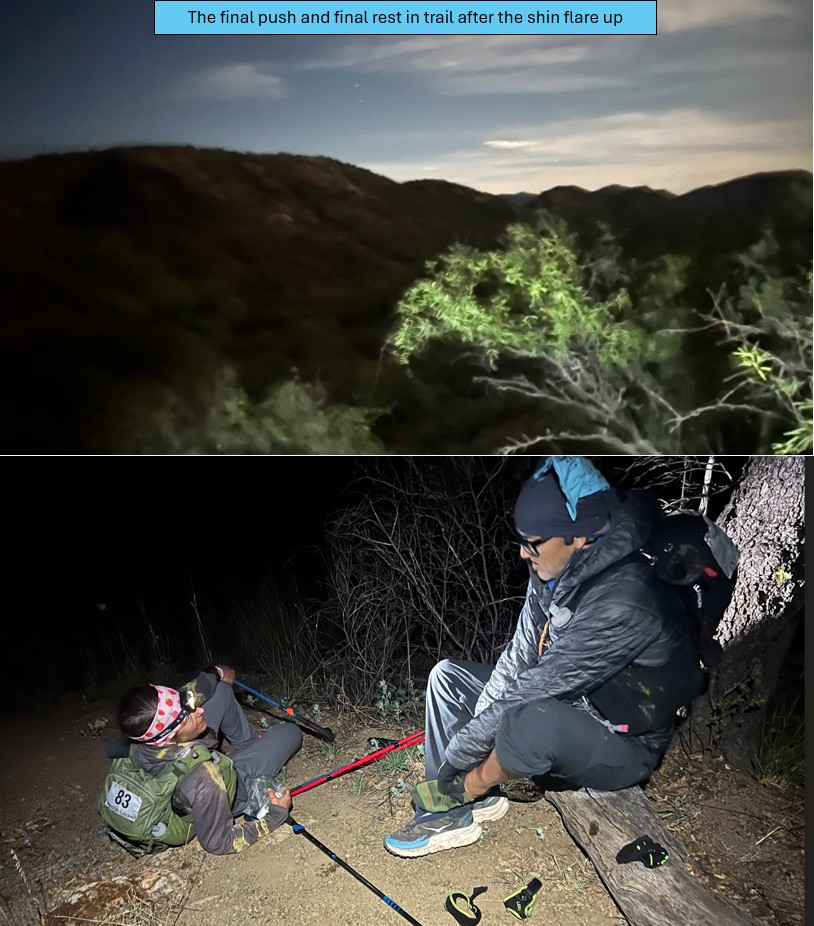
The Descent into Patagonia
The technical, rocky descent gave way to the blacktop. The flat black top road should have been a relief, but to my feet, it was a skillet. Govinda and Carolyn were howling with excitement, their voices echoing in the chilly night air, but I was silent. I was empty. I just wanted to be home.
Then, the darkness broke. I saw them, Salima and Rayna.
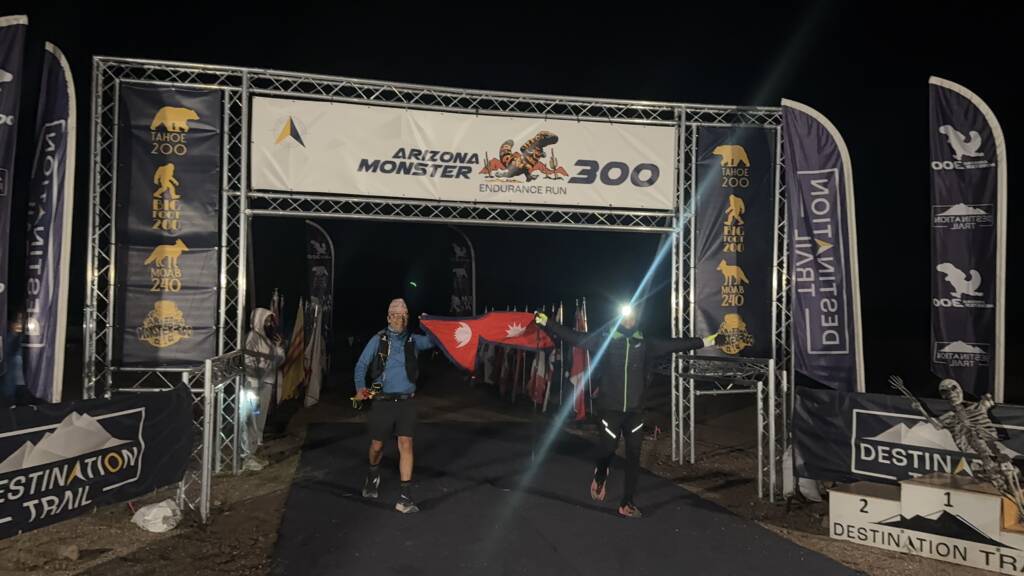
Salima handed me the Nepali flag. Its jagged peaks matched the horizon we had just conquered. Govinda and I gripped the fabric together, two sons of Nepal, 305 miles later, walking with the pride of a community on our shoulders. Crossing that line was not a sprint; it was a relief. Seven days. Seven nights. I pulled Rayna and Sali into a hug, the two young women who had chased us through the dust and kept us fed when we wanted to quit.
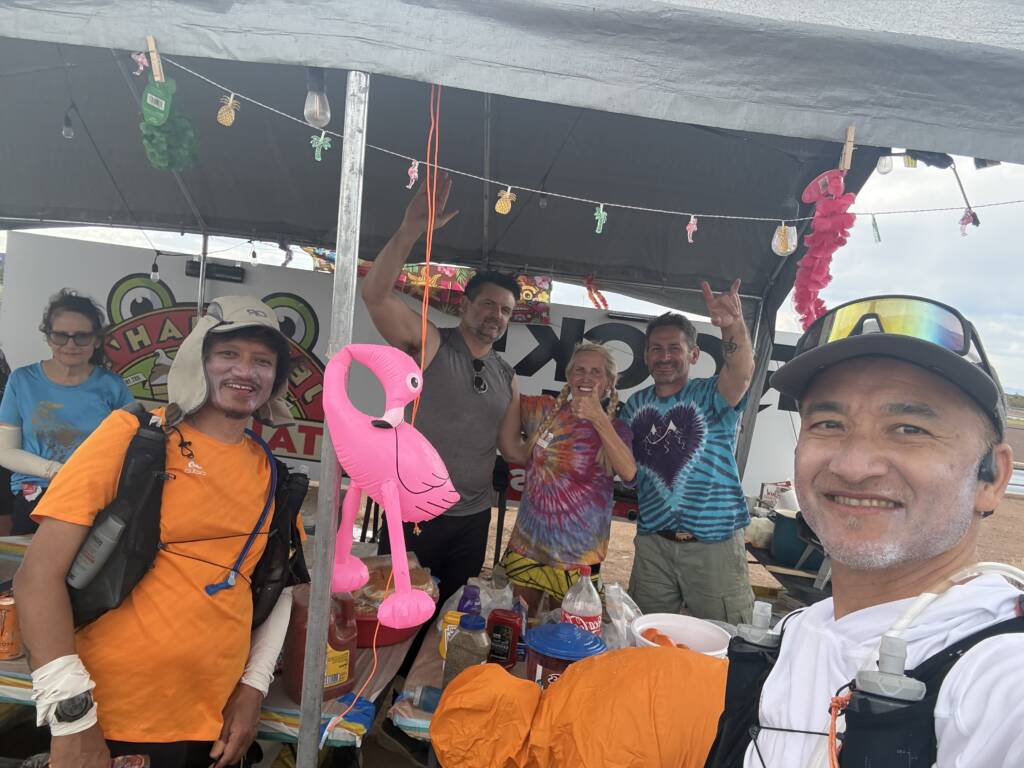
Sharing stage with Rayna and Sali who tirelessly followed and fed us through this entire adventure
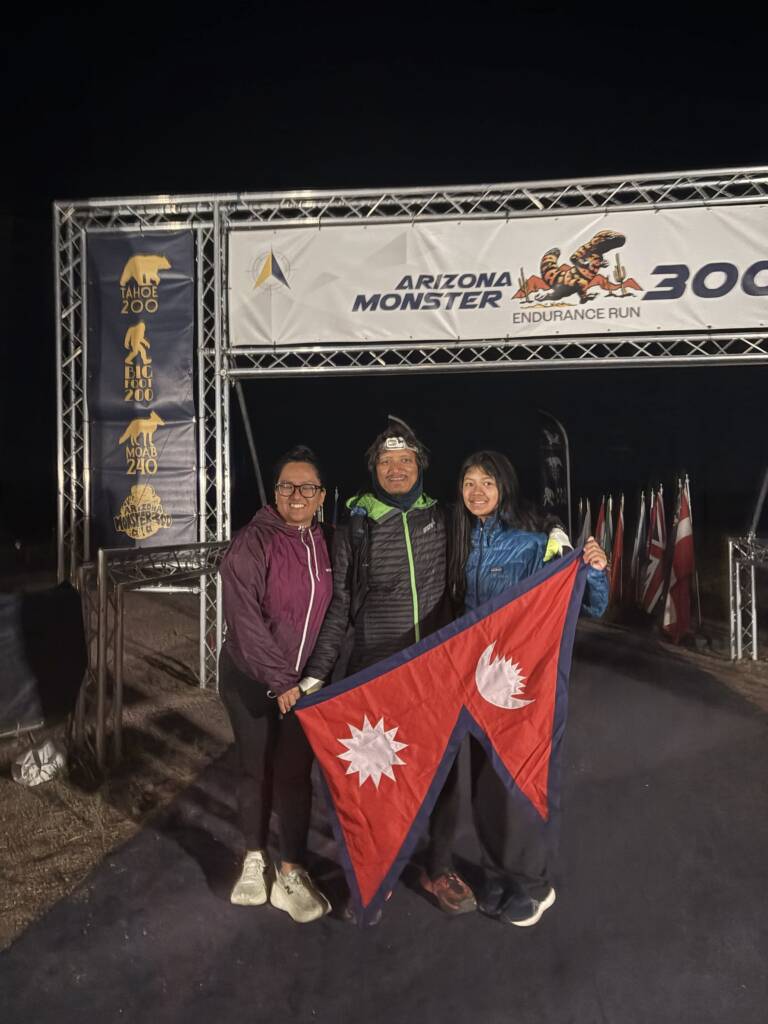
The ritual is complete. The ‘Monster’ is quiet. The son of a farmer has finished his work.
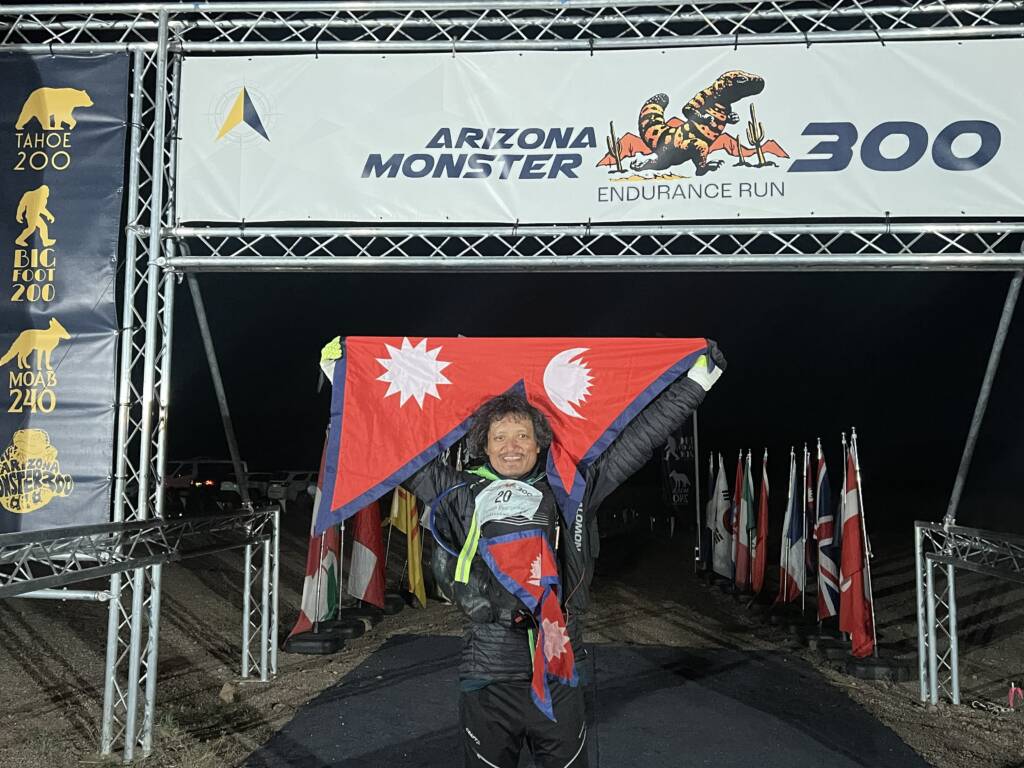
CUSTOMARY BEFORE AND AFTER MUG SHOT (thank you Destination Trail for pictures)
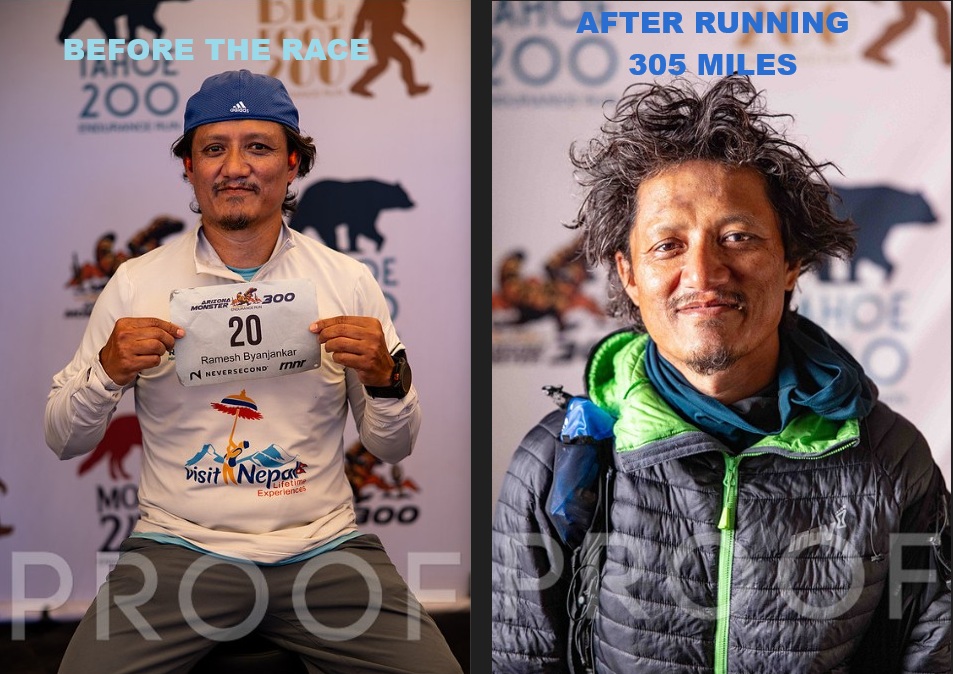
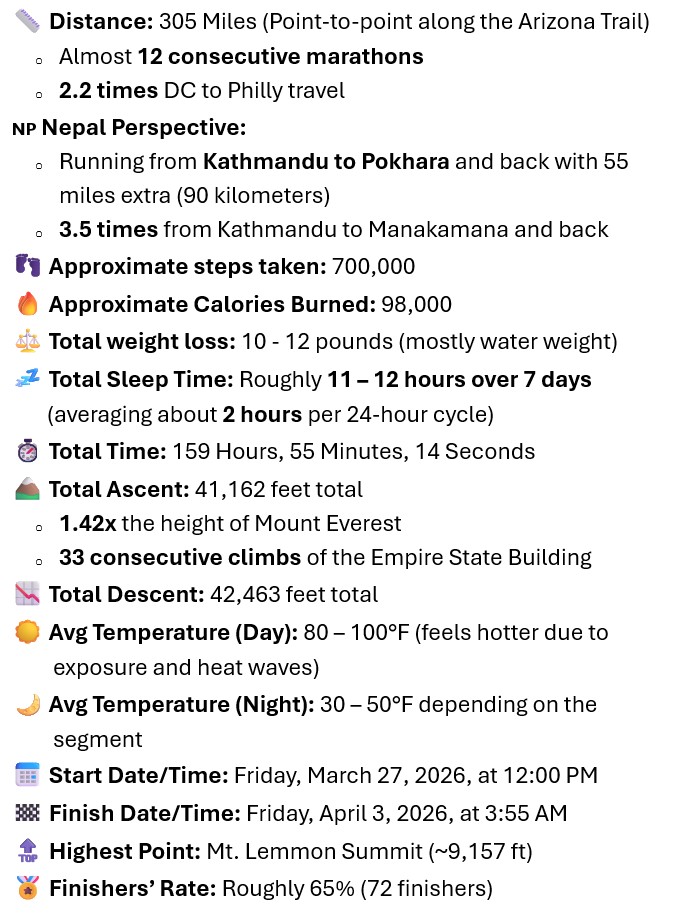
OFFICIAL RACE STATS
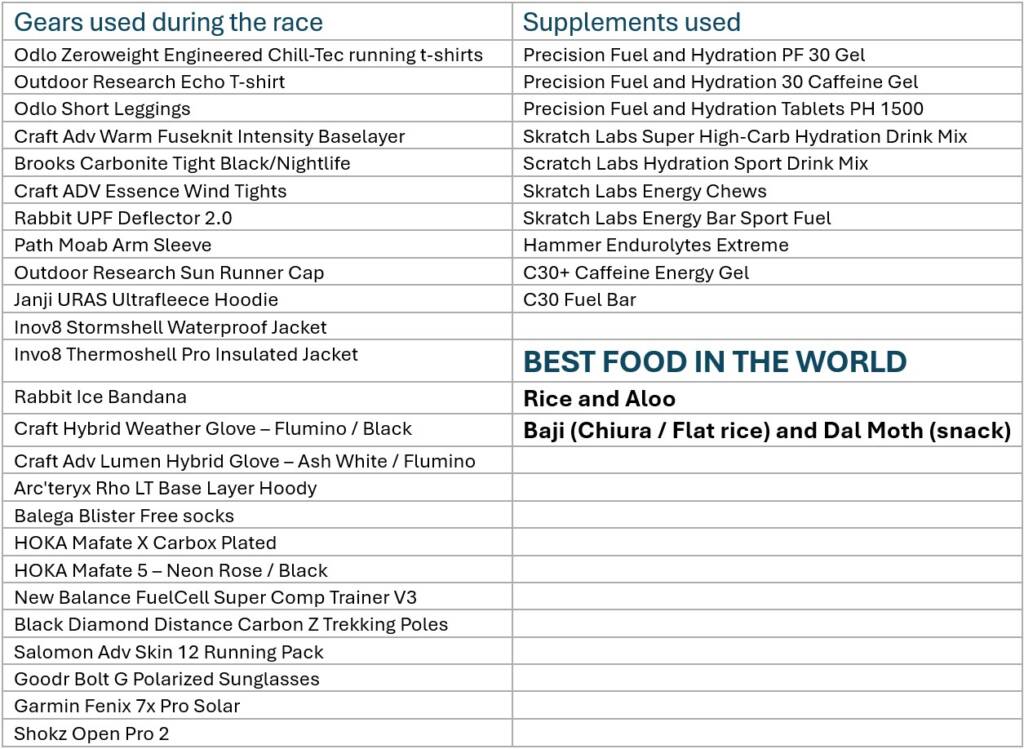
Gears Used during the race
HOW I AM RECOVERING?
Social Fuel: The Kishor Connection
Joking about calling Kishor for coffee while on the trail was a survival mechanism; actually, sitting down with him is the reward. Sharing those stories over a meal helped me transition my brain from “race mode” back to “human mode.”
The “Fry an Egg” Feet and The ‘Oil and Ice’ Recovery Strategy
The burning sensation of my feet is receding.
The Cold Dip: This is the best way to flush out the lingering metabolic waste. By constricting the blood vessels, I hope I am forcing my body to cycle in fresh, oxygenated blood once the feet warm up again.
The Oil Rub: This is a crucial “Nepal-style” recovery move. Massaging the feet with oil not only rehydrates the skin that was “scorched” on the blacktop but also stimulates lymphatic drainage. It helps move the fluid out of those toes that were screaming on Day 7.
The Sleep Debt Interest
The 3-Hour Cycle: My body was essentially trying to force into a polyphasic sleep cycle. Since I survived on 90-minute and 20-minute naps for a week, feels like my brain decided that three hours of wakefulness is the new “maximum.” It is a survival mechanism that takes time to unlearn.
The Time Zone “Double-Whammy”: Shifting from Arizona Time back to Eastern Time (ET) added a 3-hour jet lag on top of a 140-hour sleep deficit. My internal clock (circadian rhythm) was looking for the sunset in Tucson while I was already dealing with the morning rush in Maryland.
The “Ultra-Brain” Fog: When you are sleep-deprived, the prefrontal cortex, the part of the brain effectively goes offline. I was operating on pure “lizard brain” (eat, walk, sleep), which is why I felt like a zombie.
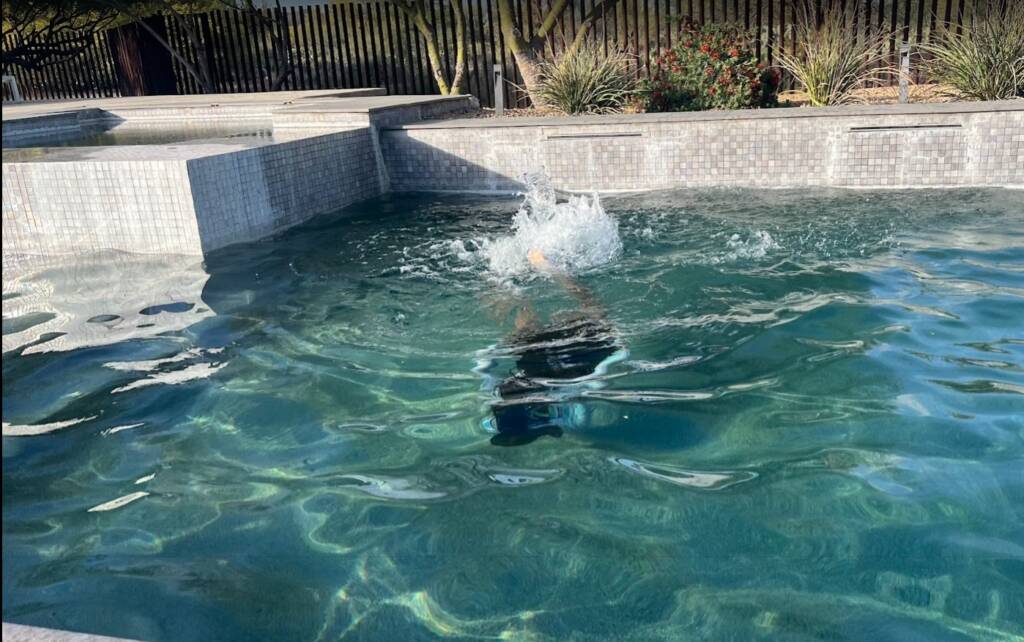
Swimming: The Weightless Reset
After 42,463 feet of descent, my joints have taken a massive pounding. Swimming is the ultimate recovery tool because it provides hydrostatic pressure, which helps reduce the lingering swelling in lower limbs, and it allows to get heart rate up without any impact on those “burning” feet. Using Jacuzzi and Sauna is helping in my recovery. This is what I called “Hydrotherapy”
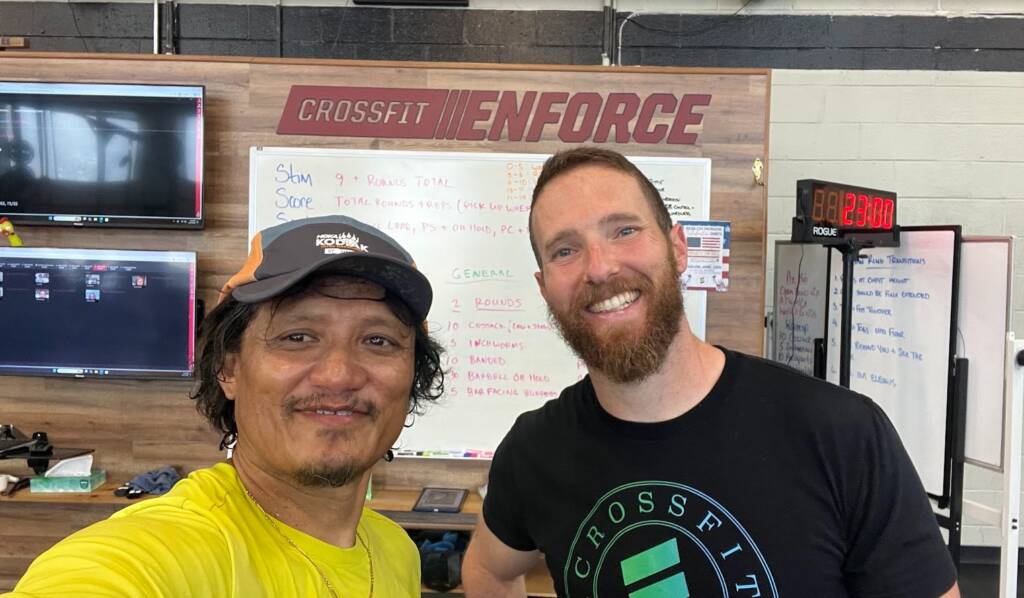
CrossFit: Rebuilding the Chassis
Returning to CrossFit Enforce and seeing the coaches and CrossFit family is helping me recover from my muscle fatigues. I am slowly integrating the strengthening and stability workout for my future run. However, I am making sure that I do not rush myself and get injured. Having the coaches keeps you honest. Thank you all coaches, Flavia, Maria, Ben, Tyler, Maddie, Leah and all. A snap with coach Ben.
Chiropractic Integration
I really appreciate the support from Dr. Christina at Integrative Chiropractic and Rehabilitation; her expertise is essential for my recovery, focusing on decompressing the kinetic chain to relieve the intense pressure on my discs and joints after days of carrying a pack through technical terrain.
A special thanks to below listed people and organization. It meant a lot for your constant support and love.
Shakti Regmi
Prafulla Karki
Umesh Sharma
Nepal Education and Culture Center (NECC)
CURIOUS TO KNOW WHAT’S NEXT ON THE AGENDA? THE RACE?
STAY TUNED… IT’S COMING SOON !!!